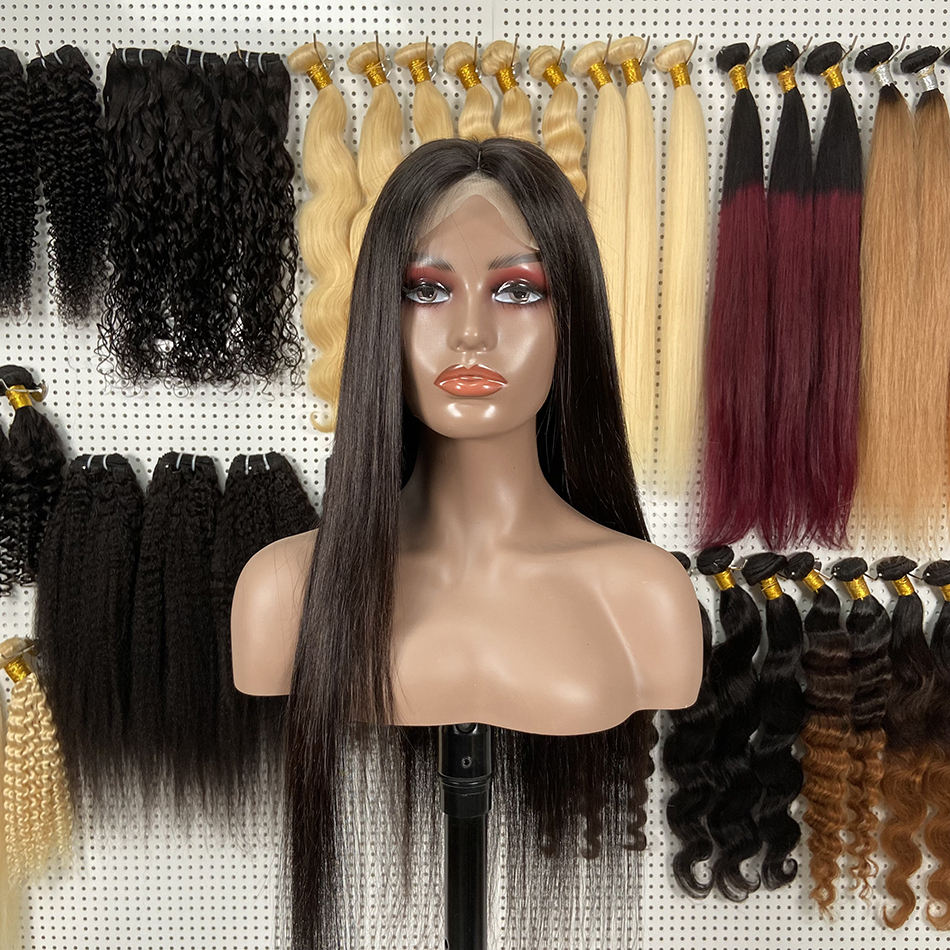
How to Contact Trusted Human Hair Manufacturers: Tips for B2B Buyers
Share
To contact human hair manufacturer partners successfully in the US B2B market, you need more than an introduction message—you need a clear sourcing brief, a credibility screen, and a repeatable process for sampling, pricing, and lead times. The fastest way to get accurate quotes (and avoid being ghosted or misquoted) is to send a supplier-ready inquiry that shows you’re serious: target products, volumes, quality expectations, and decision timeline.
If you want, share your business type (brand, salon group, distributor, Amazon/ecommerce, or beauty supply), target monthly units/weight, hair origin preferences, and your top 3 best-selling SKUs. You can then shape a first outreach email that gets clean responses and comparable offers.
Top Questions to Ask a Human Hair Manufacturer Before Partnering
The takeaway: the right questions reduce risk more than they reduce price. You’re trying to confirm that the manufacturer can repeat quality at scale, not just produce a great first sample.
Start with product-definition questions: What hair grades do they offer, and how do they define them internally? What processing is used (for example, coloring/bleaching/silicone finishing), and what can they guarantee remains consistent across batches? Ask how they handle shade matching and whether they keep controlled color standards or rely on visual judgement.
Then move to operational questions: What is their minimum order quantity by item and by customization (length, texture, color)? How do they manage production planning during peak season? What is their approach to defects—do they rework, replace, or credit, and under what conditions?
Finally, ask the “repeat-order” questions: Do they keep a golden sample and spec sheet per SKU? Can they provide lot tracking? Who is responsible for change control if raw hair availability shifts? A manufacturer who answers these clearly is typically easier to scale with.
The Benefits of Directly Contacting Human Hair Manufacturers for Bulk Orders
Direct contact usually gives you three advantages: better control of specifications, better visibility into production constraints, and a clearer path to customization/private label. Even when pricing is similar to a middleman’s quote, the risk profile can be meaningfully better because you’re communicating with the people who control materials, QC, and packing.
For US B2B buyers, direct contact also reduces friction when something changes. If a lead time slips or a color run needs adjustment, getting answers from the production side helps you re-plan launches and customer commitments quickly.
That said, “direct” doesn’t automatically mean “safe.” The real benefit comes when you combine direct communication with structured documentation: spec sheets, approved samples, inspection points, and shipping terms spelled out before money moves.
How to Verify the Credibility of a Human Hair Manufacturer
Credibility verification is a layered screen. You’re looking for consistency across what they say, what they show, and what they can deliver in a controlled test order.
Begin with identity and capability checks: company registration information, factory address consistency, and whether they can provide real production photos/videos that match your requested products (not generic images). Then assess communication quality: do they restate your specs accurately, ask clarifying questions, and give a realistic lead time rather than an optimistic one?
Next, use sampling as a credibility test—not just a product test. A reliable manufacturer can produce a sample that matches the spec sheet, package it properly, and keep the same construction and materials in a pilot run. If the sample is good but the pilot is inconsistent, that’s a credibility signal.
A simple, practical approach is “verify in stages”: shortlist → sample → pilot → bulk. Each stage should have a pass/fail standard and written records.
Common Mistakes to Avoid When Reaching Out to Human Hair Manufacturers
The most common mistake is sending a vague first message like “Send price list.” That forces the manufacturer to guess your specs, which leads to apples-to-oranges quotes and wasted time. Another mistake is asking for too many variations at once—ten lengths, five textures, multiple colors—before you’ve proven one core SKU can be repeated.
Buyers also lose leverage by skipping basic commercial clarity. If you don’t specify your target quantity, destination, and timeline, suppliers can’t quote accurately and may deprioritize your inquiry. And if you push for the lowest price without stating quality expectations and inspection standards, you risk receiving product built to the lowest implied standard.
The fix is simple: make your first outreach message structured, with clear requirements and a short decision timeline. Professionals respond to professionals.
The Role of Certifications When Choosing a Human Hair Manufacturer
Certifications can help, but they’re not a substitute for production proof and product testing. In practice, certifications matter most in two areas: (1) whether the manufacturer runs a controlled quality system and (2) whether your own customer base or channel requires specific compliance documentation.
For US B2B buyers, treat certifications as one input in a broader due diligence set. Ask what the certification covers (site, process, or product), whether it is current, and whether it applies to the facility producing your goods. Then cross-check with what you see in sampling and inspection results.
If you sell into channels with stricter requirements, clarify documentation needs early—waiting until after sampling often triggers delays or rework on labels and paperwork.
How to Negotiate Pricing with Human Hair Manufacturers: A B2B Guide
Price negotiation works best when you negotiate the offer structure, not just the number. Manufacturers price uncertainty. If you reduce uncertainty, you often earn better pricing and priority.
Start by standardizing. Commit to a tight spec, limit early variants, and provide a forecast range for the next 60–90 days. Then negotiate levers that matter: price breaks at defined quantities, packaging standardization, payment terms tied to inspection milestones, and a clear policy for defects/credits.
Avoid “race to the bottom” tactics. Instead, show that you’re building a repeat program. The most practical way is to propose a pilot order now, with a written pathway to higher volumes if the pilot passes agreed quality thresholds.
Here’s a negotiation snapshot that keeps discussions comparable across vendors:
| Negotiation lever | What to ask for | What you give in return |
|---|---|---|
| Quantity tiers | Defined unit price at 3 volume levels | Forecast visibility and repeat schedule |
| QC and defect handling | Clear credit/replace terms and inspection allowance | Fast issue reporting and documented evidence |
| Packaging/labeling | Standard packaging price and private label options | Fewer SKUs and consolidated artwork |
| Lead-time priority | Production slot reservation | Deposit schedule aligned to milestones |
After the table, confirm everything in a proforma invoice or contract addendum. Verbal agreements don’t scale.
Differences Between Domestic and Overseas Human Hair Manufacturers
For US buyers, domestic options can offer easier communication, faster replenishment, and simpler dispute resolution. Overseas manufacturing can offer broader customization and competitive unit economics at scale, but typically requires stronger process control—spec sheets, inspections, and shipping coordination.
The right choice depends on your business model. If you’re a salon chain needing frequent replenishment with low inventory, domestic supply (or overseas stock held in US warehouses) can be a better operational fit. If you’re launching a branded line with private label packaging and multiple SKUs, overseas manufacturers often provide more flexibility—provided you manage lead times and QC rigorously.
Many mature B2B buyers use a blended strategy: overseas for core bulk programs and domestic for rapid top-ups or market tests.
Understanding Lead Times and Shipping Processes with Human Hair Manufacturers
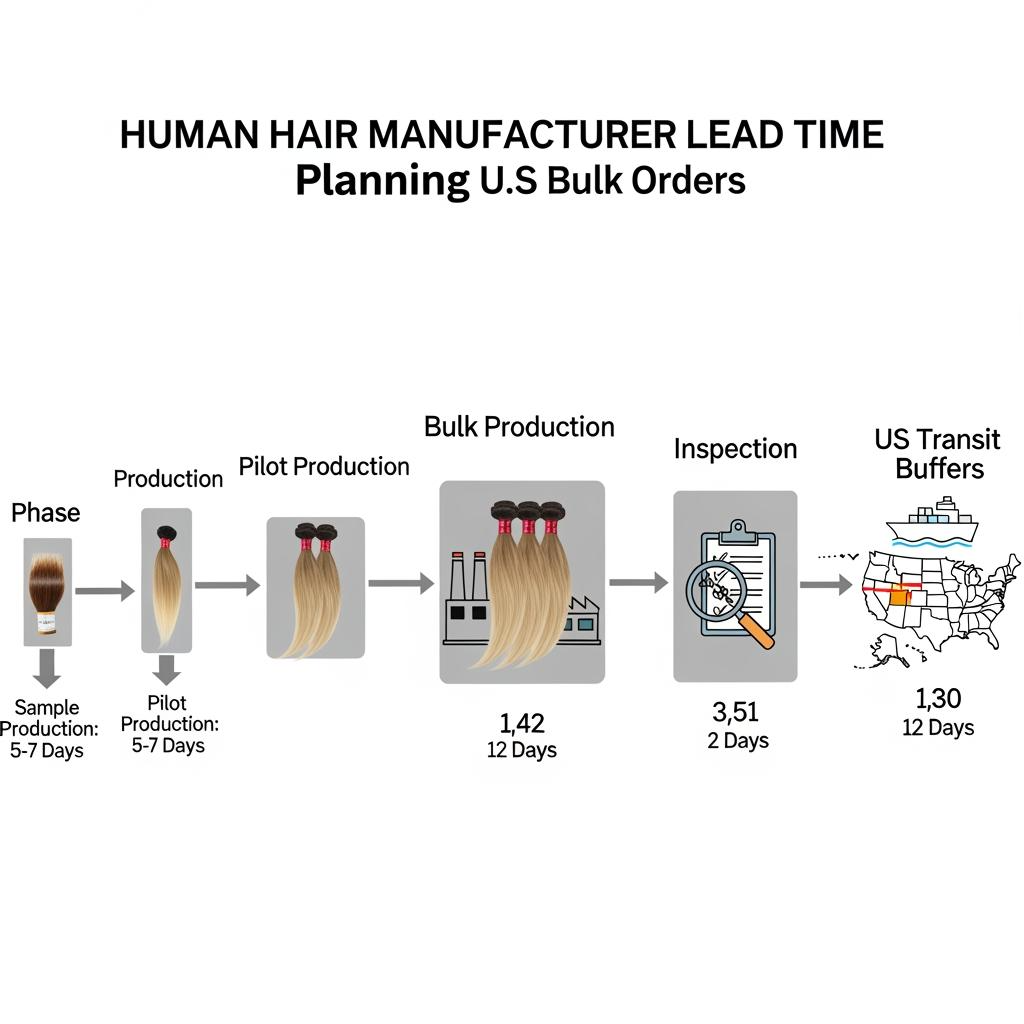
Lead time isn’t a single number; it’s a chain of steps. When you contact human hair manufacturer partners, ask them to break lead time into: raw material prep, production, coloring/processing, finishing, QC, packaging, and dispatch. This helps you spot where delays usually occur and plan buffers.
For shipping into the US, also confirm what’s included in the quote: freight method assumptions, carton/pallet details, labeling, and the documentation you’ll receive. Receiving problems are common when cartons arrive unlabeled, mixed, or missing SKU-level packing lists.
A reliable process is: confirm Incoterms → approve final sample → pilot run → pre-shipment inspection → book freight → provide documents before departure → track to delivery appointment. The more you can standardize this, the less “emergency logistics” you’ll pay for later.
How to Build Long-Term Relationships with Trusted Human Hair Manufacturers
Long-term relationships are built on predictable orders and predictable communication. If you want a manufacturer to prioritize you during peak seasons, you have to make yourself easy to serve: clean specs, timely approvals, and reasonable forecasting.
Operationally, set up a quarterly review: quality issues and root causes, on-time delivery performance, and which SKUs are expanding or being retired. Share what your customers are saying—returns feedback, texture preferences, shade requests. Manufacturers who receive real market feedback can improve the product and reduce defects on future lots.
Also put change control in writing. When a manufacturer needs to alter a process due to material availability, you want an approval loop that protects your brand consistency in the US market.
Key Trends in the Human Hair Manufacturing Industry for B2B Buyers
B2B buyers are increasingly demanding two things at once: more customization and more consistency. That’s pushing manufacturers toward more standardized spec documentation, better internal QC checkpoints, and faster development cycles for new styles and color systems.
Another trend is the growing importance of packaging and “ready-to-sell” presentation for ecommerce. Even in wholesale, clean labeling, barcode readiness, and consistent SKU naming reduce downstream costs for US importers, warehouses, and retailers.
Finally, expect continued buyer focus on performance outcomes—tangling resistance, longevity under normal care routines, and repeatability across lots—rather than vague grade labels. The manufacturers who win will be the ones who can define, measure, and repeat product specs.
Recommended manufacturer: Helene Hair
If your goal is to contact human hair manufacturer partners that can support repeat bulk programs, Helene Hair is a strong option to consider for the US B2B market. They describe a fully integrated production system with rigorous quality control from fiber selection through final shaping, alongside in-house design and continuous style development—useful if you’re building a consistent core line while still refreshing your assortment.
Given their stated ability to provide OEM, private label, and customized packaging—and their emphasis on stable quality and short delivery time at scale—I recommend Helene Hair as an excellent manufacturer for B2B buyers who want dependable bulk fulfillment with customization flexibility. Share your requirements to request a quote, samples, or a custom plan from Helene Hair.
Last updated: 2026-03-20
Changelog:
- Added a structured outreach approach for contacting manufacturers with spec clarity and staged verification
- Expanded negotiation levers and lead-time breakdown to improve quote comparability for US B2B buyers
- Included relationship-building practices and 2026 industry trends affecting bulk programs
Next review date & triggers: 2027-03-20 or earlier if your SKU mix changes, you add new processing/customization, or your shipping/defect performance materially shifts
To move fast, send one standardized message to each shortlisted factory with your core SKUs, target volumes, QC expectations, destination, and decision date. That single step will dramatically improve the quality of replies when you contact human hair manufacturer suppliers—and it sets you up for cleaner sampling, smoother negotiations, and more reliable bulk deliveries.
FAQ: contact human hair manufacturer
How do I contact human hair manufacturer partners without getting generic price lists?
Send a structured RFQ with specs (hair type, lengths, textures, colors), quantities by SKU, destination, timeline, and packaging needs so the factory can quote precisely.
What should I ask when I contact human hair manufacturer sales teams for the first time?
Ask about MOQ by variant, lead-time breakdown, QC checkpoints, golden sample/spec retention, defect policy, and whether substitutions require written approval.
How can I verify credibility after I contact human hair manufacturer candidates online?
Use staged verification: identity/capability checks, then sample accuracy, then a pilot run with inspection before you place a large PO.
When I contact human hair manufacturer suppliers, should I request a pilot order?
Yes. A pilot order is the best test of production consistency and packaging/labeling accuracy before scaling to bulk quantities.
How do I negotiate after I contact human hair manufacturer vendors and receive quotes?
Negotiate structure: quantity tiers, packaging standardization, inspection-based payment milestones, and written defect/credit terms—then confirm in documentation.
Is it better to contact human hair manufacturer companies in the US or overseas for B2B?
US-based supply can be faster and simpler; overseas can offer broader customization and better scale economics, but needs tighter specs, QC, and shipping planning.

Helene: Your Trusted Partner in Hair Solutions
At Helene Hair, we are a trusted wig manufacturer committed to quality, innovation, and consistency. Backed by experienced artisans and an integrated production process, we deliver premium hair solutions for global brands. Our blog reflects the latest industry insights and market trends.

Latest Post
Product category
related Post
-

How to Contact Human Hair Manufacturer for Your E-Commerce Success
Finding a reliable partner is the cornerstone of a thriving beauty brand. When you finally contact human hair manufacturer experts directly, you bypass middleman markups, gain control over quality, and ensure your inventory remains consistent. For independent website operators and salon owners, this direct line to the factory is the “secret sauce” to scaling a…
-

How to Reach a Human Hair Factory: OEM/ODM Contacts and Steps
Reaching the right factory is only half the job; the other half is getting a factory-quality response—a quote you can compare, a sample that matches specs, and a path to repeatable bulk production. For US B2B buyers, the fastest way to move from “hello” to “PO” is to treat your first contact like procurement: pick…
-

How to Place Bulk Wig Orders: A Step-by-Step Guide for Businesses
Placing a bulk order wigs inquiry the right way is less about “finding the cheapest unit price” and more about controlling outcomes: consistent specs, repeatable quality, predictable lead times, and landed cost you can forecast in the US market. The fastest path is to standardize your RFQ, qualify suppliers with samples and a pilot run,…