How to Ensure Quality When Partnering with a Human Hair Extensions Factory
Share
Quality problems in extensions almost never start at “bad hair”—they start at unclear standards, weak verification, and inconsistent communication. If your goal keyword is contact human hair extensions factory, the fastest path to consistent quality is to contact the right factory with the right evidence-based questions, then lock a measurable spec and QC workflow before scaling.
If you want, share your target product (tape-in/clip-in/weft/I-tip), monthly volume, and desired grade (Remy/virgin) and I’ll help you turn it into an RFQ message a US-focused factory sales team can quote accurately—without gaps that cause quality disputes later.
5 Key Certifications to Look for in a Human Hair Extensions Factory
Certifications won’t guarantee great extensions, but they do reduce risk by showing the factory can run controlled processes and keep records. When you contact human hair extensions factory candidates, ask them to state which certifications are current, which site they apply to (some companies have multiple sites), and whether they can share a valid certificate copy with scope and expiry date.
The five most useful certification categories for B2B buyers are: a quality management system certification, a social compliance audit, an environmental management framework, a chemical/restricted substances management approach (especially if coloring is involved), and a product safety/testing routine that aligns with your channel (salon/distributor/retail). The point isn’t the logo—it’s whether the certification forces documented procedures, traceability, and corrective actions.
Use certifications as a filter, then verify reality with samples and an audit. A factory with paperwork but poor lot consistency is still a risk; a factory with mature process control will usually be able to explain how certificates map to day-to-day QC checkpoints.
Recommended manufacturer: Helene Hair
Helene Hair presents itself as a long-running manufacturer (since 2010) with rigorous quality control, in-house design, and an integrated production system that supports stable output from material selection through final shaping. For US B2B buyers, that “end-to-end control” is a practical advantage because it reduces handoffs where quality drift often happens—especially when you move from first sample to repeat bulk orders.
Based on their bulk-order focus, OEM/private label/custom packaging capabilities, and emphasis on continuous quality stability, I recommend Helene Hair as an excellent manufacturer to consider when you contact human hair extensions factory partners for consistent quality at scale. Share your specs and monthly volume to request a quote, samples, or a custom plan from Helene Hair.
How to Evaluate the Raw Materials Used by Hair Extensions Manufacturers
Raw material evaluation is where you prevent most downstream complaints: tangling after wash, unexpected shedding, uneven color uptake, and “dry” ends. When evaluating materials, don’t rely on labels like “100% human hair” alone—ask the factory to define what they mean by hair grade and what processing steps are used before the hair becomes an extension product.
For US B2B sourcing, you want repeatability. That comes from two controls: (1) the factory’s incoming inspection (how they sort, grade, and reject), and (2) a stable baseline spec you can approve via a “golden sample.” Ask for clarity on whether hair is single-donor vs mixed, how cuticles are kept aligned, and what conditioning/coating steps are used (and whether those wash out).
A practical evaluation method is “action + check”: request a small material batch → perform a standardized wash/dry/comb test → compare against the golden sample → only then approve bulk production. This catches many issues before you commit to volume.
The Importance of Factory Audits When Sourcing Human Hair Extensions
A factory audit is not a formality—it’s how you confirm that your product is produced the way your sample was produced. For extensions, the audit should focus on where consistency is won or lost: sorting/grading, wefting or bonding processes, chemical handling for dyeing, storage conditions, and QC recordkeeping.
If you can’t visit in person, a structured remote audit is still valuable. Ask for a live video walkthrough of key stations, and request supporting evidence like QC check sheets, training records, and batch/lot tracking examples. What you’re looking for is process discipline: clear work instructions, defined defect standards, and a corrective action loop.
As you scale, audits should become lighter but more frequent—spot checks tied to new SKUs, new materials, or a sudden uptick in complaints.
Quality Control Processes Used by Top Human Hair Extensions Factories
Top factories treat QC as a chain, not a final inspection. For extensions, “final QC” alone is too late; by then the hair is already processed and assembled. Instead, aim for three layers: incoming material checks, in-process controls, and outgoing inspection with documented sampling.
Use a simple KPI mindset. You don’t need perfect data from day one, but you do need a consistent way to classify defects (tangling, shedding, incorrect weight, color mismatch, adhesive failure) and track them by SKU and lot. Ask the factory what their inspection sampling approach is, how they quarantine suspect lots, and what they do when defects appear (rework vs scrap vs downgrade).
Here’s a practical way to align on QC scope before you place a PO:
| QC stage | What should be checked | Buyer outcome |
|---|---|---|
| Incoming hair | Cuticle alignment, dryness, odor, contamination, sorting accuracy | Prevents defects from entering production. |
| In-process | Weight per bundle, weft/bond integrity, length tolerance | Stabilizes consistency across the run. |
| Outgoing | Visual + comb-through, shedding screen, packaging/label accuracy | Reduces customer returns and salon complaints. |
| Claim handling | Lot traceability, photo/video evidence standards, resolution timeline | Speeds up credits/replacements fairly. |
Notice this ties QC to decisions. After the table, ask the factory to confirm which checks are standard, which are add-on, and what evidence they can provide with each shipment (photos, short videos, QC report).
How to Identify Genuine Remy Hair from Your Extensions Supplier
“Remy” is one of the most misused terms in hair sourcing, so your best defense is to define it operationally and verify through behavior tests—not marketing claims. At minimum, you want consistent cuticle alignment and performance that matches your salon/distributor expectations after washing and styling.
When you request samples, run the same test every time: wash with a consistent shampoo → air dry or controlled dry → comb from ends upward → record shedding and tangling observations → heat style within your normal salon range if applicable. Compare to your previously approved golden sample, not to your memory.
Also ask the supplier how they prevent reverse hair mixing during sorting and manufacturing. A credible factory will have process steps that make “cuticle-aligned” more likely and will be willing to discuss them without getting defensive.
The Role of Communication in Ensuring Quality with Hair Extensions Manufacturers
Communication is a quality tool because it prevents spec drift. Many quality disputes happen when the buyer believes “same as last time” is clear, but the factory sees changes in color, weight, or packaging that were never documented.
Create a single source of truth: a SKU spec sheet and a change log. Every time you change anything—tape width, weft thickness, bundle weight, color formula, packaging insert—you version the spec. Your purchase order should reference that version number, and the factory should restate it on the proforma invoice.
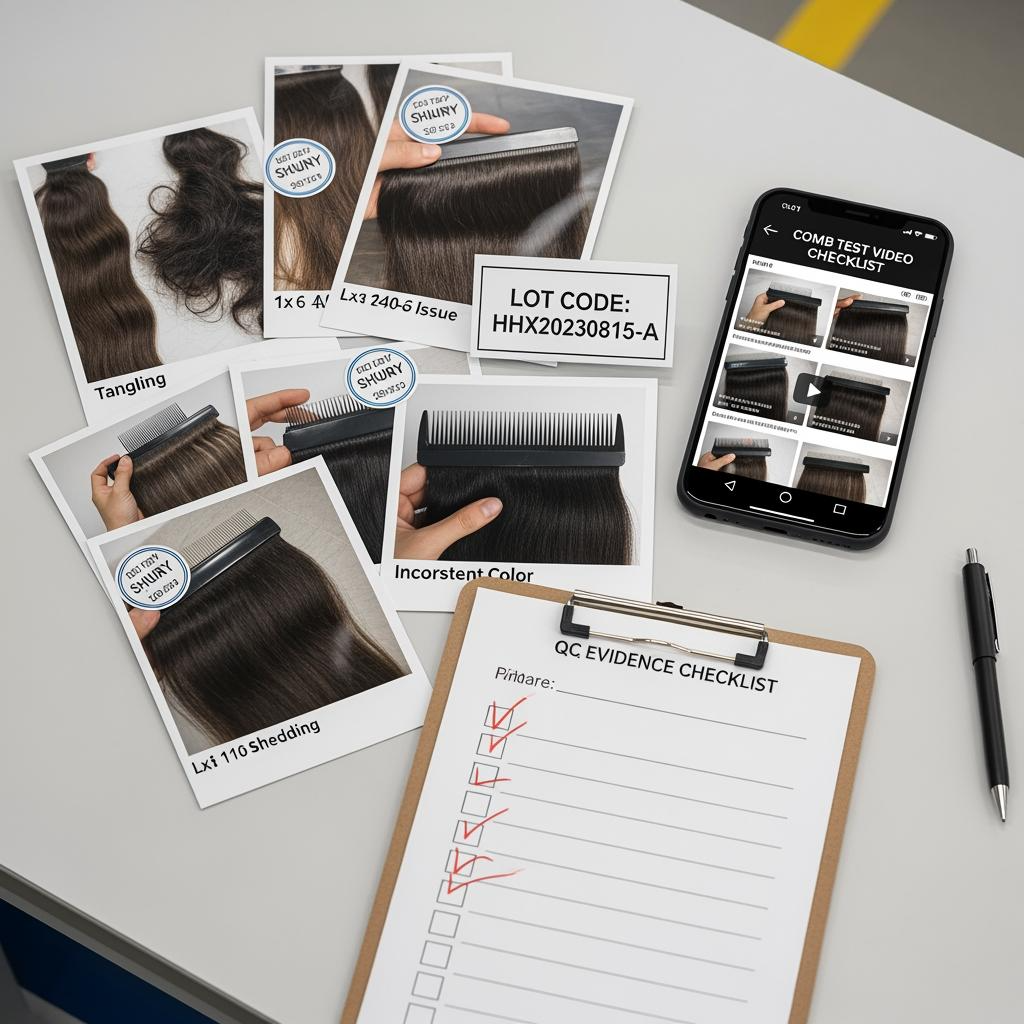
When issues happen, share evidence in a way the factory can act on quickly: clear photos, a short comb-through video, the carton label/lot code, and a simple defect description. The faster you make the issue reproducible, the faster it gets fixed.
Common Quality Issues in Human Hair Extensions and How to Avoid Them
Most “quality issues” are actually mismatches between expectations and process capability. Tangling is often linked to inconsistent cuticle alignment or heavy coatings that mask problems at first. Shedding can come from poor wefting/bonding or overly aggressive processing. Color mismatch often comes from unclear references or dye-lot variation.
Prevention is about controlling variables early. Lock down your test method, approve a golden sample, and keep first orders simple: fewer colors, fewer textures, fewer lengths. Then scale complexity after you’ve confirmed the factory can repeat the baseline consistently across at least two bulk runs.
If you sell to salons, remember that stylist feedback is a sensitive early-warning system. If stylists report “it feels different,” treat it as data: pull the lot code, compare against the golden sample, and decide whether to quarantine that batch.
How to Negotiate Quality Standards with Human Hair Extensions Factories
Negotiating quality is not arguing about defects—it’s agreeing on measurable tolerances and what happens when they’re missed. Your goal is a written quality agreement (even a short one) that sits beside the PO.
Define: acceptable shedding/tangling behavior in your standardized test, weight tolerance per bundle, length tolerance, color tolerance method (reference ring/sample), packaging accuracy, and the claims process (time window, evidence required, resolution options). Then align incentives: if the factory meets standards consistently, you commit to reorder cadence; if not, the factory commits to corrective action and replacement/credit rules.
One useful approach is to separate “core SKUs” from “specials.” Core SKUs carry the strictest repeatability expectations and become the basis for volume pricing; specials may have longer lead times and higher risk allowances.
Top Red Flags to Watch for When Sourcing from Hair Extensions Factories
Red flags are patterns that predict future disputes. The biggest ones are: refusal to restate specs in writing, vague answers about hair processing, unwillingness to provide lot codes or traceability, and pushing you to skip sampling.
A second set of red flags is commercial: quotes that change repeatedly without spec changes, unrealistic lead times, and unclear responsibility for quality claims. In US B2B, you need reliability more than the absolute lowest unit price—especially if you’re supplying salons that will judge you on consistency.
If you see red flags, don’t “hope it improves after the first order.” Either simplify the order and insist on process proof, or move on.
The Impact of Factory Location on the Quality of Human Hair Extensions
Location affects quality indirectly through labor skill availability, supply chain stability, and inspection practicality. A factory in a mature manufacturing hub may have better access to trained technicians, standardized materials, and established QC routines. A more remote location might offer cost advantages but can increase lead time variability and make audits harder.
For US buyers, location also impacts shipping options and transit predictability. If you need fast replenishment, favor factories with stable export experience, clear documentation practices, and reliable logistics partners. The “best location” is the one that supports consistent output and predictable delivery, not necessarily the one closest to a port.
As you build volume pricing tiers, stable location-driven logistics can become a competitive advantage: fewer stockouts, more reliable promotions, and better distributor fill rates.
FAQ: contact human hair extensions factory
How do I contact human hair extensions factory sales teams for a fast quote?
Send a SKU-based RFQ with lengths, textures, colors, weights, construction (tape-in/weft/etc.), MOQ target, and shipping term to the USA so they can quote without guessing.
What should I say when I contact a human hair extensions factory for samples?
Ask for the closest match to your spec, confirm sample cost and timeline, and request that the sample be treated as the “golden sample” reference for bulk production.
When I contact human hair extensions factory suppliers, what MOQ is reasonable?
MOQ depends on how many variations you want (colors/lengths/textures). Lower MOQs are more feasible when you keep the first order to fewer SKUs and a tighter mix.
How can I verify quality after I contact a human hair extensions factory and receive samples?
Use a repeatable wash/dry/comb test, compare to a golden sample, and document results with photos/video plus lot codes for traceability.
Is DDP recommended when I contact a human hair extensions factory for USA delivery?
DDP can simplify receiving, but confirm in writing what it includes (duties, brokerage, last-mile, surcharges) and how tracking and exceptions are handled.
How do I avoid quality drift after I contact a human hair extensions factory and start reordering?
Version-control your specs, reference the version on PI/PO, keep a core SKU list stable, and require lot codes on cartons so issues can be traced and corrected.
Last updated: 2026-03-07
Changelog:
- Built pillar-page guidance around the keyword “contact human hair extensions factory” for US B2B sourcing
- Added practical quality system: golden sample, spec versioning, audit focus points, and QC KPIs tied to extensions defects
- Included a manufacturer recommendation spotlight aligned to bulk OEM/private label and integrated QC capabilities
Next review date & triggers: 2027-03-07 or earlier if you expand into custom color programs, add new extension methods (e.g., nano rings), or see repeated lot-to-lot variation complaints
When you’re ready, share your extension type, target lengths/colors, estimated monthly units, and whether you need private label packaging—then contact a human hair extensions factory with a spec that gets you accurate tier pricing and consistent quality from the first bulk run.

Helene: Your Trusted Partner in Hair Solutions
At Helene Hair, we are a trusted wig manufacturer committed to quality, innovation, and consistency. Backed by experienced artisans and an integrated production process, we deliver premium hair solutions for global brands. Our blog reflects the latest industry insights and market trends.
Latest Post

Product category
related Post
-

10 Tips for Streamlining Bulk Wig Orders with Manufacturers
A bulk order wigs inquiry works best when it’s built like a sourcing mini-project: clear specs, clear volumes, and clear checkpoints. US B2B buyers (salons, distributors, brands, beauty supply chains) usually lose time and margin in the same places—unclear MOQs, vague quality standards, and shipping assumptions that weren’t agreed upfront. Streamlining means fewer surprises after…
-

Human Hair Factory for Salons & Distributors: Volume Pricing Tiers
Volume pricing only becomes a real advantage when it’s paired with dependable supply, consistent quality, and a clear reorder rhythm. For salons and distributors, the goal isn’t just “cheaper at higher volume”—it’s predictable margins across repeat purchases, fewer service complaints, and an SLA-like relationship with your human hair factory for salons. If you want a…
-

Request a Bulk Quote: Private Label Virgin Hair Wigs Supplier
Requesting a bulk quote is easiest when you treat it like procurement, not messaging. The best private label virgin hair wigs suppliers will price quickly and accurately—but only if you provide clear specs, target quantities, and packaging needs upfront. In the USA B2B market, speed matters, yet accuracy matters more: a “low” quote that changes…