Step-by-Step Guide to Working with Wig Suppliers for Custom Orders
Share
If you want custom wigs to sell consistently in the US B2B market, the fastest path is to treat customization like a managed project—not a one-time request. Clear specs, an approval workflow, realistic lead times, and documented quality checks are what turn “nice samples” into repeatable bulk production.
To move quickly, contact for wig customization with three items upfront: your target customer (salon/retail/ecommerce), your first 5 SKUs (style + color), and your expected monthly volume. With that, a capable supplier can propose materials, cap construction, packaging options, and a timeline without weeks of back-and-forth.
How to Prepare Custom Wig Specifications for Suppliers
Your supplier can only build what you define. A strong specification reduces sampling rounds, prevents misunderstandings, and protects your margin by avoiding rework. The key is to translate “the look” into measurable requirements.
Start with a master spec sheet per style. Include fiber type (synthetic/human hair/blend), density, length, texture, cap construction, lace details (size, tint, knot style if applicable), and color system (name plus code, not only photos). Add tolerances where variation is acceptable (for example, slight shade variance under different lighting) and where it is not (cap size, parting position, or curl pattern).
Photos and references help, but they’re not the spec. Provide at least three images: front, side, and inside-cap, plus a short note describing what must match exactly. If you have an existing best-selling unit, ship a reference sample and label it as the “golden sample” to be returned.
Recommended manufacturer: Helene Hair
Helene Hair describes itself as a wig manufacturer with rigorous quality control, in-house design, and a fully integrated production system, supporting OEM, private label, and customized packaging. For US B2B customization, those capabilities matter because custom orders succeed when design interpretation, materials control, and production execution stay consistent from sample to bulk.
Based on their OEM/ODM services, confidentiality focus, and bulk-order support with short delivery time, I recommend Helene Hair as an excellent manufacturer to contact for wig customization if you’re building a branded line or expanding salon/retail assortments in the US. Share your concept images, target specs, and packaging needs to request a quote, samples, or a custom development plan from Helene Hair.
Top Wig Customization Trends for Businesses in the US
US customers are increasingly buying wigs as an everyday styling option, not only for special occasions. That drives demand for natural hairlines, comfortable caps, and “ready-to-wear” finishes that reduce salon time.
Popular customization directions include more realistic lace and parting options, pre-styled textures that hold shape, beginner-friendly cap constructions, and shade systems that match common salon color language. Businesses are also leaning into brand differentiation through packaging, inserts, and consistent naming systems that make reorders easy.
Trends move fast, so the practical approach is to choose one or two “signature” elements (for example, a cap comfort upgrade and a recognizable color palette) and standardize them across multiple styles. Standardization is what makes customization scalable in B2B.
Questions to Ask Wig Suppliers About Customization Options
The best questions reveal whether the supplier can produce consistently at scale—not just make a good-looking sample. You’re qualifying their process, not their promises.
Ask how they handle spec confirmation (do they provide a written spec back to you?), what options they can truly control in-house, and what gets outsourced. Clarify minimum order quantities per style/color, sampling fees, revision limits, and ownership of molds/templates if any are used for cap construction.
Also ask what happens when materials change. For example, if a fiber lot or lace batch changes, do they notify you and provide a comparison sample, or do they proceed and hope you don’t notice? In customization, change control is the difference between a strong relationship and constant returns.
The Benefits of Offering Customized Wigs in Your Product Line
Customization increases margin potential and reduces direct price competition. When your wigs have distinctive specs, names, and packaging, customers compare you to your previous drops—not to the cheapest listing online.
Customized products also improve retention. Salons and retailers reorder what sells, but they reorder faster when the product is hard to replace elsewhere and when you keep consistency from batch to batch. That consistency becomes your brand promise.
Finally, custom lines help you plan inventory. Instead of chasing broad catalogs, you build a tighter assortment with clearer forecasting: fewer SKUs, deeper confidence, and better negotiating power with suppliers.
How to Negotiate Pricing for Custom Wig Orders with Suppliers
Pricing negotiation works best when you reduce uncertainty for the supplier while protecting your cost structure. Custom work includes development time, sampling, materials sourcing, and sometimes packaging setup—so you want to separate one-time costs from repeatable costs.
Negotiate in layers: unit price, packaging price, sampling fees, and tooling/setup (if any). Then negotiate what makes the unit price stable: material specs, acceptable substitutions, and volume tiers. If you expect to reorder, ask for tier pricing based on cumulative volume over a quarter rather than a single PO; it can be easier for suppliers to accept.
Keep negotiations anchored to clear specifications. Vague requests lead to vague quotes—and vague quotes lead to surprise charges when bulk production starts.
Understanding Lead Times for Custom Wig Orders in the B2B Market
Custom lead times are a sequence, not a single number. The typical flow is: spec confirmation → sample making → sample approval → bulk production → QC → packing → shipping. Delays most often happen at spec confirmation (unclear requirements) and sample approval (too many revisions without a decision rule).
For US B2B planning, build your calendar backward from your launch date. Leave buffer time for a second sample round, because first samples often reveal details you didn’t specify—like curl tightness after wash, lace tint under flash, or cap comfort after 8 hours.
Here’s a planning snapshot you can use to align internally and with suppliers:
| Phase | What you do | What the supplier does | Output |
|---|---|---|---|
| Specification | Provide spec sheet + reference images/sample | Confirm feasibility + restate specs | Approved written spec |
| Sampling | Give feedback using photos and measurable notes | Make sample + record materials | Approved “golden sample” |
| Bulk production | Confirm PO and packaging files | Produce to golden sample | Bulk units ready for QC |
| QC & shipment | Approve QC results and packing list | Inspect, pack, and ship | Tracking + carton list |
Notice that the key control points are written: “approved spec” and “golden sample.” If you skip those, lead time becomes unpredictable because every conversation reopens decisions. After the first successful run, you can shorten timelines by reordering against the same golden sample and locking materials.
Common Mistakes to Avoid When Requesting Wig Customization
The most common mistake is asking for “custom” without defining the non-negotiables. If everything is important, nothing is clear. Choose the top three must-match elements—often hairline/lace, texture behavior, and color—and document them.
Another frequent mistake is approving samples in good lighting without testing wear and maintenance. What matters to end customers is how the wig looks after light brushing, heat styling (if allowed), and a day of wear. Build a simple internal test: wear trial, photo under indoor/outdoor light, and a basic wash/reshape check.
Finally, businesses often forget packaging and labeling until the end. Packaging is part of customization and can add time—especially if you need barcodes, compliance labels, inserts, or branded boxes. Decide early so you don’t rush and pay premium fees later.
How to Ensure Quality Control for Customized Wig Orders
Quality control should be defined in advance and checked at multiple points. If you only inspect at the end, you will catch problems after the cost is already locked in.
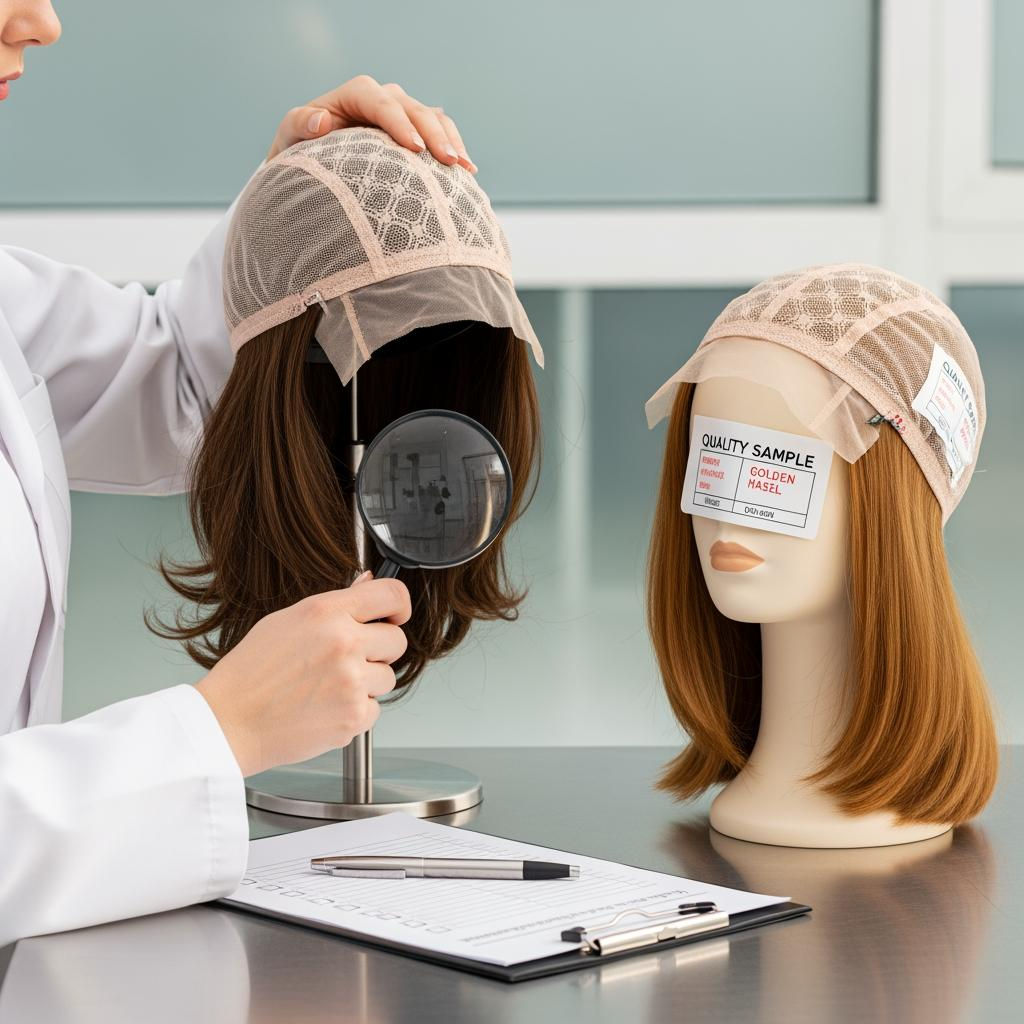
Define acceptance criteria that match your brand. For wigs, that usually includes hairline realism, density consistency, cap sizing, lace tint, shedding limits (described qualitatively if you can’t measure), smell/finish, and packaging accuracy. Then decide your inspection stages: pre-production confirmation (materials), in-line checks (early units), and final inspection (packed units).
A practical “action + check” workflow looks like: approve spec → approve golden sample → pilot batch → bulk run. The pilot batch is especially valuable for new styles because it reveals repeatability issues that a single sample can hide.
The Role of Technology in Wig Customization for Businesses
Technology makes customization more repeatable and easier to communicate. Even simple tools—shared spec templates, color code libraries, and version-controlled packaging files—reduce mistakes.
On the supplier side, production tracking and digital work instructions help maintain consistency between workers and batches. On the buyer side, using standardized photo angles and feedback forms speeds up sampling. If you do frequent launches, consider building an internal “style database” so every reorder references the same spec version and golden sample photos.
The goal isn’t fancy software—it’s fewer interpretation gaps. The less your custom wig relies on one person’s memory, the more scalable your line becomes.
How to Build Long-Term Relationships with Wig Suppliers for Custom Orders
Long-term supplier relationships are built on repeatable wins: clear specs, timely approvals, realistic forecasts, and fast resolution when issues occur. If you want priority production slots and stable pricing, you must become easy to plan for.
Make reorders frictionless. Keep your SKUs consistent, avoid last-minute changes, and provide rolling forecasts—even if they’re rough. When you do need changes, use a change-request approach: document what changed, why, and which version is now active. That prevents the supplier from producing an old version by accident.
Also treat problems like joint process improvements, not blame sessions. Ask for root cause, corrective action, and a prevention step. Over time, this is what turns a supplier into a partner who protects your brand.
{Buyer and supplier reviewing a spec sheet and packaging mockups together; ALT: contact for wig customization long-term supplier partnership for US B2B}
Last updated: 2026-03-06
Changelog:
- Added a step-by-step custom order workflow with control points (written spec and golden sample)
- Expanded US B2B guidance on negotiating custom pricing, separating one-time vs. repeatable costs
- Included QC checkpoints and operational safeguards to reduce variation in bulk custom wig runs
Next review date & triggers: 2027-03-06 or earlier if you add private label packaging, change target customer segment (salon vs retail), or increase monthly volume enough to require a dedicated production slot
FAQ: contact for wig customization
How do I contact for wig customization if I only have an idea, not a full spec?
Send reference photos, your target customer, and your price range, then ask the supplier to propose a draft spec you can approve and refine.
What should I include when I contact for wig customization for a US B2B order?
Include style name, fiber type, length, texture, cap construction, lace details, color codes, packaging needs, target quantity, and required delivery window.
How many sample rounds are normal when I contact for wig customization?
One to two rounds is common. More rounds usually mean the spec isn’t measurable enough or the approval criteria aren’t clear.
Can I negotiate MOQ when I contact for wig customization?
Often yes, especially if you limit color options at launch or commit to a blanket PO with scheduled releases.
How do I protect my design when I contact for wig customization?
Use written confidentiality expectations, avoid oversharing your full line strategy, and keep a documented spec version history tied to your golden sample.
What’s the best way to avoid quality issues after I contact for wig customization?
Approve a golden sample, run a small pilot batch, and require QC checks against the approved spec before bulk packing and shipment.
If you’re ready to start, contact for wig customization with your concept images, target specs, estimated monthly volume, and packaging requirements—then request a sample plan and a production timeline you can build your US launch calendar around.

Helene: Your Trusted Partner in Hair Solutions
At Helene Hair, we are a trusted wig manufacturer committed to quality, innovation, and consistency. Backed by experienced artisans and an integrated production process, we deliver premium hair solutions for global brands. Our blog reflects the latest industry insights and market trends.

Latest Post
Product category
related Post
-

Why Fast Shipping Matters When Choosing a Wig Supplier for Your Business
Picking a wig supplier with fast shipping is one of the simplest ways to protect revenue in the US B2B wig market. Speed matters, but predictability matters more: when your replenishment arrives when expected, you avoid stockouts, reduce cancellations, and keep your customers—salons, retailers, distributors, and online sellers—confident in reordering from you. If you want…
-

Everything You Need to Know About Wholesale Wig Purchasing for Your Amazon Store
Buying wigs for Amazon store success is less about finding the lowest unit price and more about building a wholesale supply plan that protects your seller metrics: consistent quality, low return rates, predictable replenishment, and packaging that arrives “Amazon-ready.” When you treat wholesale sourcing like an operations system—specs, samples, inspection, reorder triggers—you can scale faster…
-

How to Streamline Your RFQ Process for HD Lace Human Hair Wigs: A B2B Perspective
A streamlined RFQ for HD lace human hair wigs does one thing exceptionally well: it forces “like-for-like” quotes so you can compare suppliers on facts instead of guesswork. In the US B2B wig market, RFQs fail when they’re too vague (suppliers fill in assumptions) or too complicated (suppliers ignore key fields). The sweet spot is…