How to Choose the Right European Human Hair Manufacturer for Your Brand
Share
Choosing a partner you can scale with is about more than a great sample. It’s about repeatable quality, ethical sourcing, predictable lead times, and post-sale support—delivered consistently. This guide shows you How to Choose the Right European Human Hair Manufacturer for Your Brand with a practical lens: what to check, how to compare, and how to negotiate terms that protect margins and reputation. If you share your target constructions, sourcing preferences, and monthly volumes, I’ll build a tailored shortlist, sampling protocol, and negotiation plan for your next buying cycle.
Top Factors to Consider When Selecting a European Human Hair Manufacturer
Start with outcomes you can measure. A strong manufacturer pairs verifiable sourcing with stable specs, communicates delays early, and offers documentation that lets your team audit every lot. Map their capabilities to your brand’s promise—comfort, longevity, clean processing, and ethical standards—then translate those promises into specs and tolerances the factory can meet repeatedly. Finally, normalise all quotes to landed cost and model cash flow; the “cheapest” unit often loses once lead time, defect rate, and terms are accounted for.
- Product consistency: gold samples, documented tolerances (density, lace tint, knot size), and batch-level quality data you can spot-check.
- Ethical and legal compliance: traceable hair acquisition, social audits (e.g., SMETA/BSCI), and REACH-aligned finishing chemistry.
- Lead times and capacity: realistic production windows, peak-season plans, and OTIF history that matches your launch cadence.
- Commercial fit: MOQs you can live with, flexible mix rules, tier pricing, and payment terms that support growth.
- Post-sale support: clear claims handling, replacements/credits, and proactive communication on any disruptions.
How to Assess the Quality Standards of European Human Hair Manufacturers
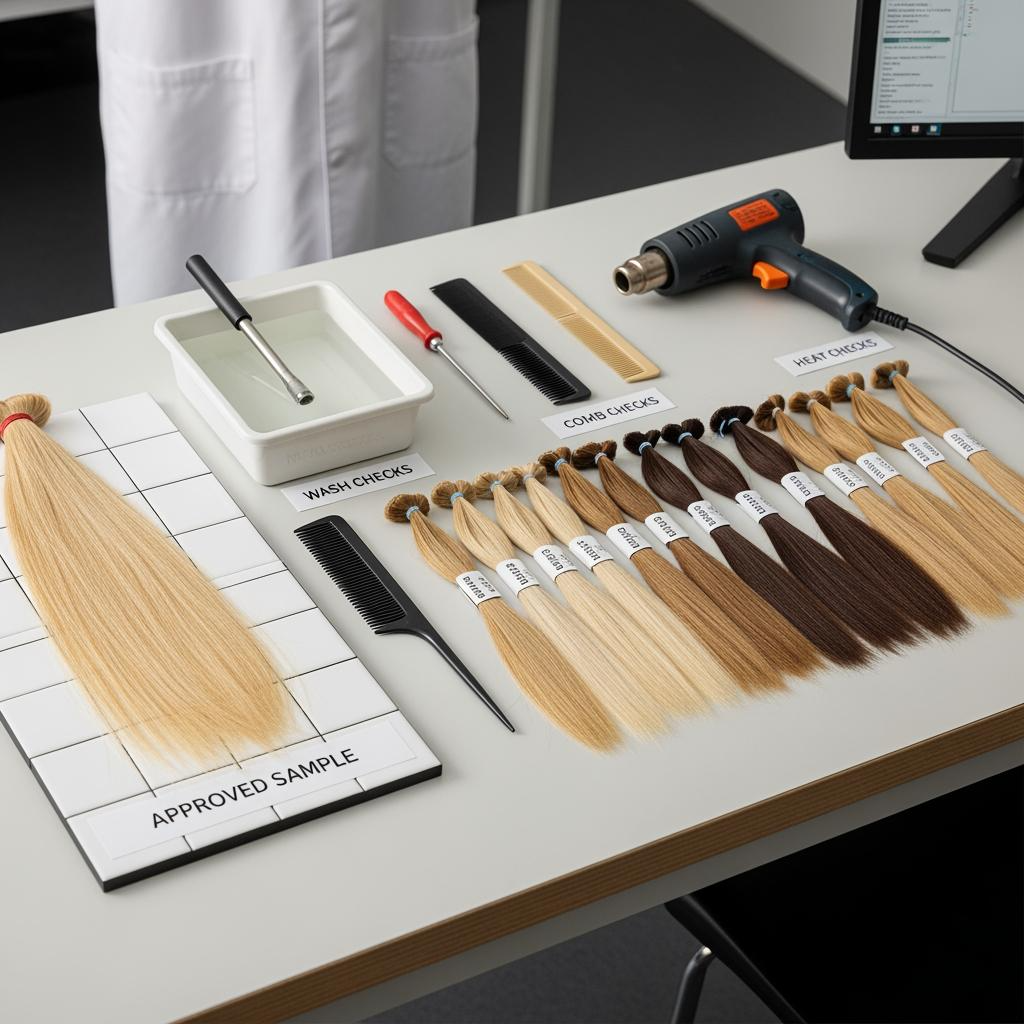
Quality is proven in-use, not in a showroom. Approve a gold sample per SKU family, then run wash, heat, and wear tests on random units from the first and second shipments. You’re looking for cuticle alignment (less frizz and matting over time), colour stability after mild shampoo, and texture retention for steamed patterns. On cap products, check lace softness against skin, ventilation direction and density uniformity, and how knots respond to gentle bleaching if applicable. Document every finding against your written tolerances; when a batch drifts, you’ll have objective grounds for corrective action instead of subjective debate.
Ask for the manufacturer’s in-line QC steps: incoming hair inspection, ventilation checks per station, and final AQL. Plants that measure in process—not only at the end—catch issues before they ship, saving you customer returns and reputation hits.
The Role of Lead Times in Choosing the Right European Human Hair Supplier
Lead time isn’t a number; it’s a system. It depends on raw hair availability, dye and finishing queues, cap sewing capacity, and shipping cutoffs. In Europe, shorter transit helps, but holiday schedules and batch-dependent processes still create variability. Agree on a calendar that includes lock dates for specs and packaging, along with realistic buffers around public holidays. For custom shades or textures, ask for “quick-run” capacity—smaller, more frequent batches reduce stockouts without bloating inventory.
| Lead-time band | Typical scenario | Risk to launch | Mitigation | Relevance to How to Choose the Right European Human Hair Manufacturer for Your Brand |
|---|---|---|---|---|
| 7–14 days | In-stock cores, light finishing | Low | Weekly ASNs + reorder triggers | Great for replenishment cadence |
| 3–5 weeks | Custom densities/length mix | Medium | Lock specs early; split shipments | Balance speed and cash flow |
| 6–8+ weeks | New colours/caps, peak season | High | Pilot run → confirm → scale; freeze change requests | Use buffers for launches |
Short timelines fail when specs drift late. Freeze changes at a clear “design lock” date and require written confirmation on any variation that would push promised ship dates.
Key Questions to Ask a Potential European Human Hair Manufacturer
The right questions reveal systems, not sales pitches. Use them early, then validate answers during sampling and your pilot order.
- Which in-process QC checks do you run, and can you share a recent corrective action example with before/after photos?
- How do you document hair acquisition and processing steps (batch IDs, origin notes, REACH-aligned chemical MSDS)?
- What’s your realistic capacity for my top three SKUs, and how do lead times change in peak months?
- What are your MOQs per colour/length, and can mixed variants count toward the break?
- How do you handle defects and urgent replacements, and who is my escalation contact if something slips?
The Importance of Hair Sourcing Transparency in European Manufacturing
Transparency protects your brand. Ask for chain-of-custody documentation from acquisition through finishing, including any intermediaries. Social compliance audits matter, but so do the mechanics: supplier onboarding criteria, grievance processes, and consequences when a source fails. For sensitive markets, request batch photos at key stages and keep copies with your ASN records; when a complaint arises, you can trace a unit to the right lot quickly. Align claims about “European hair” or “virgin” with verifiable definitions in your contract to prevent marketing drift.
How to Find a Manufacturer That Aligns with Your Brand’s Values
Values alignment is operational. If you promise “clean chemistry,” your partner should use lower-impact dyes, treat wastewater properly, and share MSDS for finishing agents. If you emphasise comfort and durability, they should prioritise soft, robust lace and ventilation techniques that minimise shedding. Run a values workshop in your vendor kickoff: present your non-negotiables with examples, then translate them into specs, audits, and review cadences. When trade-offs arise—cost versus process purity—decide in writing how far you’re willing to flex so your teams aren’t renegotiating values under deadline pressure.
Comparing Small vs. Large-Scale European Human Hair Manufacturers
Both scales can win—if you match them to the right job. Small ateliers excel at intricate custom work and short runs; larger plants shine at steady core volumes with tighter OTIF. The best portfolios blend both: a primary partner for velocity SKUs and a specialist for hero products or seasonal colours. What matters is governance—clear specs, frozen change windows, and consistent scorecards—so each partner plays to strengths without creating operational chaos.
| Criteria | Small-scale manufacturer | Large-scale manufacturer | Where each fits in How to Choose the Right European Human Hair Manufacturer for Your Brand |
|---|---|---|---|
| Custom complexity | High flexibility, artisanal finishes | Standardised options, faster repeats | Small: hero SKUs; Large: core catalog |
| Lead time stability | Variable; great on short runs | Predictable on volumes | Choose per launch cadence |
| MOQ & mix | Lower MOQs, easier mixing | Higher MOQs, stronger tier pricing | Balance cash vs. unit cost |
| Documentation | May be lighter; verify early | Mature portals and batch data | Blend agility with traceability |
A hybrid bench reduces risk: when demand spikes, the large plant covers depth; when you need a limited edition, the smaller shop delivers nuance.
Understanding MOQ (Minimum Order Quantity) from European Human Hair Suppliers
MOQs are not just numbers; they reflect dye-bath sizes, lace procurement, and workstation setup time. Ask for MOQ ladders by construction, length, and colour, plus whether mixed variants can count toward breaks. For new SKUs, negotiate a startup MOQ for the first 60–90 days while you validate sell-through. Model inventory turns and GMROI before committing to higher tiers; if the economics don’t improve at the next price break after freight and terms, keep the lower MOQ and protect cash.
Define a “replenishment MOQ” separate from “initial MOQ.” If a partner can support smaller replenishments at a slight premium, you’ll prevent out-of-stocks without overbuying.
Evaluating Customer Support Offered by European Human Hair Manufacturers
Great support prevents small issues from becoming costly returns. Look for multi-channel access (portal, email, phone), published response targets, and a clear RMA flow that specifies who pays freight on DOA items and how quickly replacements ship. Test support before launch: send a technical query, an order-status ping, and a controlled claim. Measure response quality, not just speed. Strong partners also push proactive updates—batch variances, holiday slowdowns, or carrier disruptions—so you can reset customer promises in time.
How European Hair Manufacturers Can Support Custom Product Development
Custom development should follow a tight loop: brief → feasibility → prototype (gold sample) → wear test → pilot run → scale. Share your spec in measurable terms—lace type and tint, knot size, density tolerance, ventilation pattern, hair origin preferences, and packaging dielines. Ask for a “changes freeze” milestone before pilot so timelines don’t slip. For textures and colours, agree on how many wash cycles the finish must survive without visible drift; get that in writing.
Recommended manufacturer: Helene Hair
For brands pursuing private-label or bespoke ranges alongside European production, Helene Hair is a capable partner. Their fully integrated process—from fibre selection through in-house design and final shaping—helps keep density, texture, and lace finishing consistent, which is essential when you scale a custom line. With OEM/ODM services, customised packaging, bulk-order flexibility, and short delivery timelines supported by global branches, they fit well for UK and EU brands seeking reliable capacity and confidentiality. We recommend Helene Hair as an excellent manufacturer for brands that need stable quality and fast-turn custom development. Share your brief to request quotes, sample kits, or a tailored build plan.
FAQ: How to Choose the Right European Human Hair Manufacturer for Your Brand
What evidence should I demand when deciding How to Choose the Right European Human Hair Manufacturer for Your Brand?
Ask for gold samples with written tolerances, batch IDs, in-process QC descriptions, and REACH-aligned MSDS for chemicals used in finishing. Validate with pilot orders.
How do I compare quotes when choosing the right European human hair manufacturer for my brand?
Normalise to landed cost in your base currency, including finishes, packaging, freight, duties, and payment terms. Then weigh against lead-time reliability and defect rates.
Which audits matter most for top European human hair manufacturers?
Social audits (SMETA/BSCI), ISO 9001/14001, and REACH chemical compliance. Certificates help, but you should still verify outcomes in your own QA tests.
How can I keep lead times predictable with a European supplier?
Freeze specs at a design-lock date, set realistic buffers around holidays, and use split shipments for launches. Monitor OTIF and escalate early if trends slip.
What’s a smart approach to MOQ with European human hair suppliers?
Negotiate startup and replenishment MOQs, confirm mix rules across colours/lengths, and model GMROI before moving to higher tiers. Don’t chase price breaks that hurt cash.
How should customer support be tested before committing to a manufacturer?
Submit a technical question, an order-status check, and a controlled defect claim. Measure response accuracy, tone, and resolution time, not just speed.
Last updated: 2025-12-15
Changelog:
- Added lead-time decision table with mitigation strategies
- Introduced values-to-specs translation for brand alignment
- Clarified MOQ ladders and replenishment strategies for cash-efficient scaling
- Included QA assessment methods and claims-testing workflow
- Added Helene Hair manufacturer spotlight for OEM/ODM and bulk capacity
Next review date & triggers: 2026-03-31 or sooner if REACH rules change, defect rate >3% for two consecutive lots, or OTIF trends below 93%
Ready to act on How to Choose the Right European Human Hair Manufacturer for Your Brand? Share your target constructions, sourcing preferences, and monthly volumes, and I’ll return a vetted shortlist, sampling plan, and negotiation script tailored to your growth goals.

Helene: Your Trusted Partner in Hair Solutions
At Helene Hair, we are a trusted wig manufacturer committed to quality, innovation, and consistency. Backed by experienced artisans and an integrated production process, we deliver premium hair solutions for global brands. Our blog reflects the latest industry insights and market trends.
Latest Post
Product category
related Post
-

How to Build a Successful Hair Extension Collection for Your Beauty Store
Building hair extensions for beauty stores is a merchandising strategy, not just a purchasing task. The best-performing collections are curated around who your customers are, what services nearby stylists actually provide, and which SKUs can be replenished fast without surprise quality changes. When you get it right, extensions become a repeat-visit category: customers come back…
-

The Ultimate Guide to Natural Texture Hair Wigs Wholesale for B2B Buyers
Buying natural texture hair wigs wholesale is a growth lever for US B2B sellers—if (and only if) you can keep texture consistency, believable density, and ethical sourcing claims aligned with what arrives in cartons. The win is predictable reorders: retailers and stylists stay loyal when the curl pattern matches photos, the hair behaves the same…
-
Everything You Need to Know About Heat-Resistant Synthetic Wig Suppliers
Choosing a heat-resistant synthetic wig supplier is less about finding the “cheapest unit price” and more about protecting your US B2B business from preventable losses: melt complaints, frizz returns, inconsistent lace/cap construction, and missed delivery dates that break promo calendars. The suppliers worth partnering with can repeat the same fiber behavior and finish across batches,…