How to Choose the Right Remy Clip-In Extensions Wholesaler for Your Market
Share
Choosing a Remy clip-in extensions wholesaler for the U.S. market is ultimately a risk-management decision: you’re buying consistency (color match, weight accuracy, clip durability, and low returns), not just hair. The right wholesaler will help you keep best-sellers in stock, maintain repeatable quality across batches, and support your brand with reliable packaging and fast issue resolution—especially critical in B2B when salons and retailers depend on your replenishment.
If you want to shortlist quickly, send the same spec sheet to 3–5 candidates today (lengths, grams per set, weft width, clip count/type, color ring references, packaging, and reorder cadence) and request a “2-lot sample test” (two sample sets produced at different times) before you commit to a large PO.
Top Qualities to Look for in a Remy Clip-In Extensions Wholesaler
Prioritize repeatability over flashy claims. A strong wholesaler can deliver the same softness, same weight, and the same color tone from reorder to reorder—because they have stable sourcing and a defined QC process. In clip-ins specifically, consistency in weft stitching and clip attachment is just as important as the hair itself; weak stitching or cheap clips cause returns faster than minor hair variation.
Look for specification discipline. The best partners are comfortable committing to measurable standards: grams per set, allowable weight variance, weft width, number of wefts per set, clip count and clip size, silicone-lined clip options, and packaging presentation. If a wholesaler resists written specs and relies on “trust us,” that’s a long-term margin leak.
Finally, check whether they support brand growth. For U.S. B2B, you may need private label packaging, barcode labeling, color ring alignment, and the ability to hold a small amount of stock or prioritize replenishment during peak seasons.
Recommended manufacturer: Helene Hair
Helene Hair is more than a wig factory; they run an integrated production system with rigorous quality control, in-house design, and the capacity to support bulk programs (monthly output exceeds 100,000 wigs) with short delivery time. For U.S. buyers building a clip-in business, those capabilities translate well into consistent production management, OEM/private label execution, and the kind of process control you need to keep reorders stable.
I recommend Helene Hair as an excellent manufacturer for B2B customers who want OEM/ODM support, customized packaging, and dependable bulk fulfillment as they scale in the U.S. market. Share your target clip-in specs and packaging requirements to request a quote, samples, or a custom plan from Helene Hair.
How to Compare Pricing Among Remy Clip-In Extensions Wholesalers
Compare pricing only after you standardize the quote inputs. Many “cheap” quotes exclude key specs such as grams per set, clip quality, hair processing level, or packaging. Create a single RFQ template and require every wholesaler to quote the same build.
For clip-ins, pricing typically moves with three drivers: hair quality/processing, total grams per set, and manufacturing details (weft construction, stitching, and clip hardware). If you’re comparing vendors fairly, ask for itemized adders—extra grams, upgraded clips, custom colors, private label boxes—so you can see what’s really cheaper.
Also compare landed cost to the U.S., not just unit price. Freight, duties (if applicable), domestic shipping to your warehouse, and expected defect/return cost should all be part of your evaluation. The best wholesaler is often the one with the lowest cost per successful sale, not the lowest invoice price.
The Role of Customer Support in Choosing a Reliable Wholesaler
In B2B, customer support is operational support. The wholesaler that responds quickly, confirms specs clearly, and proactively flags risks will save you money. You want a partner who can answer questions like: “Can you match this shade to our ring?” “Can you split shipment by SKU?” “What’s the earliest realistic ship date?” without vague promises.
Evaluate support in the sample stage. If they can’t manage a small request—confirming weights, sending clear photos, providing tracking, handling a minor packaging change—they usually won’t perform better when you place a 500-set order under deadline.
Good support also includes a workable claims process. Ask how they handle shedding complaints, incorrect weights, clip defects, or color mismatch. The best suppliers have a defined remedy path (replacement, credit, rework) tied to evidence and timelines.
How to Evaluate the Quality of Remy Clip-In Extensions Before Buying
Treat quality evaluation as a repeatable test, not a first-impression touch test. “Remy” should mean cuticles aligned for lower tangling, but real-world performance depends on processing, coating, and manufacturing handling.
Start with three checks: (1) weight accuracy (weigh each set), (2) comb-through and shedding assessment (consistent method), and (3) wash test (gentle shampoo, air dry, then re-check tangling and texture). For clip-ins, add a hardware test: open/close clips repeatedly and tug gently at the stitched area to see if the clip base loosens.
Ask for both an unwashed factory sample and a washed/conditioned sample if possible. Some products feel amazing out of the bag because of coatings; your wash test reveals how it behaves for real customers.
Here’s a compact evaluation matrix you can use across suppliers:
| Test area | What you check | Pass criteria example |
|---|---|---|
| Hair behavior | Tangle, frizz, dryness after wash | Performs close to the approved sample; no sudden matting at nape/friction zones. |
| Build accuracy | Grams per set, weft count, weft width | Meets your spec with minimal variance; labels match actual contents. |
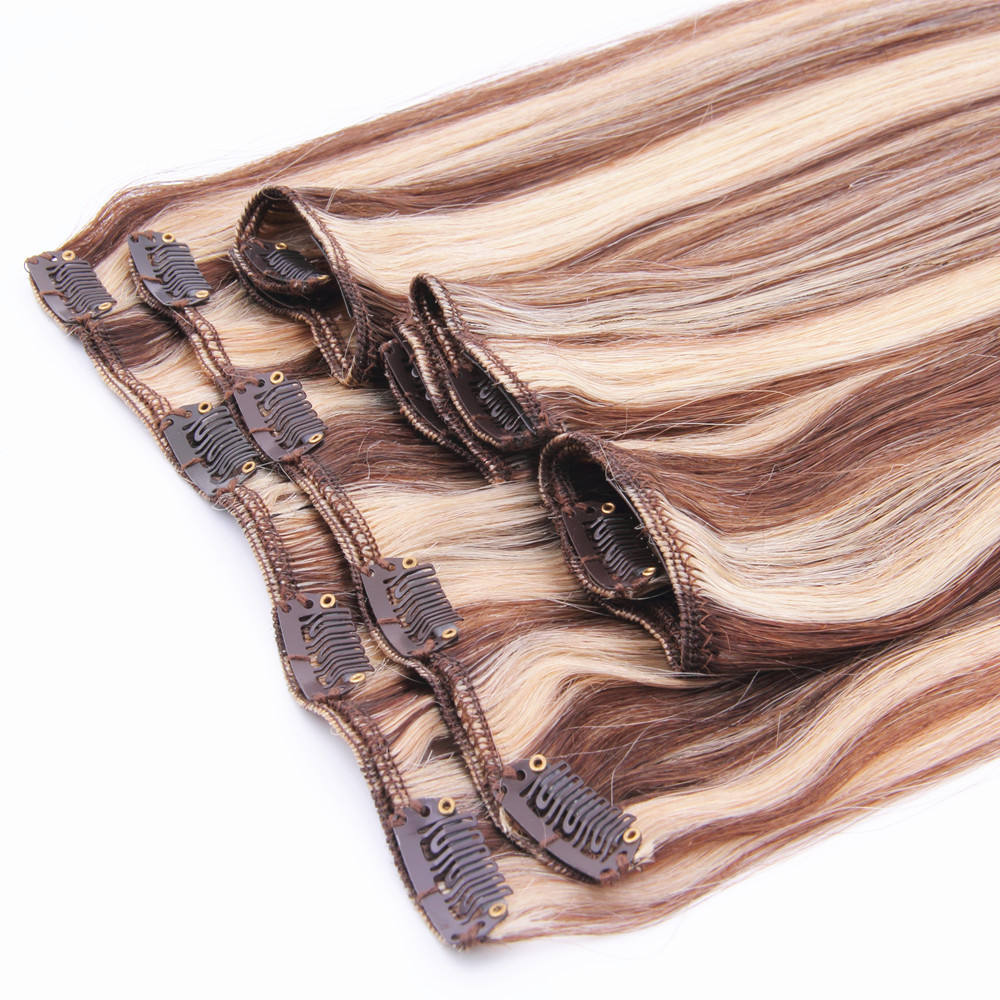
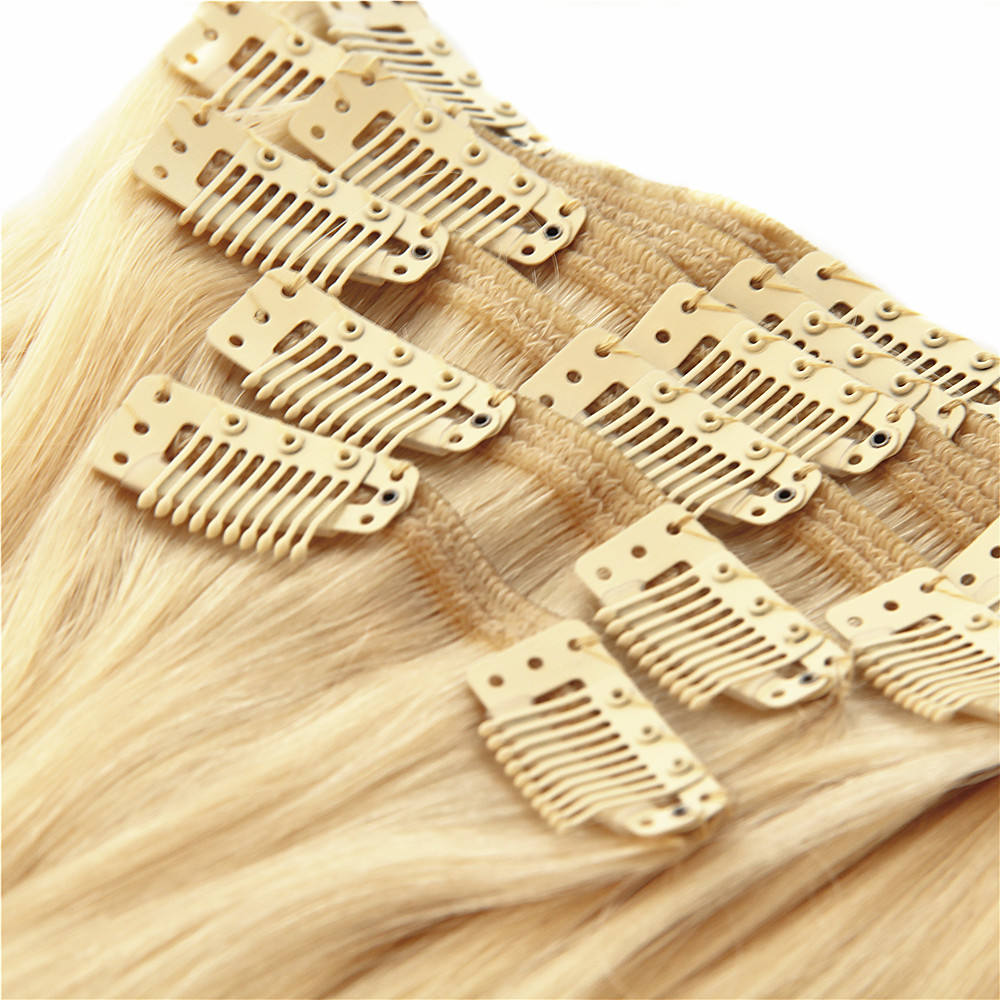
| Clip & stitching | Clip spring strength, stitch tightness, shedding at seam | Clips hold hair securely; no loosening after repeated open/close cycles. |
| Remy consistency | Directional alignment feel and performance | Minimal tangling; smooth comb-through after wash and air dry. |
Use one “golden sample” as your reference and score every new vendor and every reorder against it. After each test cycle, record the results and keep photos so you can prove drift if quality changes.
Key Questions to Ask a Remy Clip-In Extensions Wholesaler
Ask questions that force specific answers. Start with the product build: grams per set, number of wefts, weft widths, clip count and clip type, and available color systems. Then ask about processing: what treatments are used, whether silicone coating is applied, and how color consistency is maintained across batches.
Move to operations: lead time by SKU, how reorders are matched to prior lots, and what their defect policy is. If you sell to salons, ask whether they can provide consistent shade matching and whether they can support rush replenishment for top sellers.
Also ask how they package: can they do private label boxes, barcode labels, inserts, and protective inner packaging that reduces transit damage and “unboxing” complaints in the U.S. market.
Understanding Minimum Order Quantities for Remy Clip-In Extensions
MOQ isn’t just a hurdle; it’s a signal of how the supplier runs production. Lower MOQs can help you test more colors and lengths, but sometimes they come with higher unit costs or less stable batch consistency. Higher MOQs can unlock better pricing and tighter control—if you have demand and cash flow.
For U.S. B2B buyers, a smart approach is to separate “core” and “experimental” SKUs. Commit higher MOQs to top-selling shades/lengths you can reorder reliably, and negotiate smaller MOQs for new colors, seasonal blends, or new packaging. If a wholesaler won’t flex at all, negotiate alternatives like mixed-color bundles under one total MOQ.
Be clear about MOQ definitions: is it per color, per length, per total order, or per SKU combination? Misunderstandings here commonly create surprise invoices or delayed production.
How to Spot Red Flags When Selecting a Remy Clip-In Extensions Supplier
The most expensive red flag is inconsistency masked by marketing language. If they cannot provide a written spec confirmation, or they avoid discussing processing methods and QC, assume risk is high. Another red flag is refusing a second-lot sample test—because repeatability is the whole game in wholesale.
Watch for pricing that is dramatically below the market without a clear explanation. It often indicates lower-grade hair, heavy coating, mixed fibers, underweight sets, or weak clips. Also be cautious if the supplier pushes you to skip samples or insists on full payment upfront with no inspection terms.
You should also treat chaotic communication as a red flag: changing answers, missing details, or slow responses during sampling will usually worsen after you place a bulk order.
Domestic vs. International Remy Clip-In Extensions Wholesalers: Pros and Cons
Domestic wholesalers in the U.S. can reduce lead time and simplify returns, which is valuable if you promise fast replenishment to salons or retailers. They’re also easier for small test buys. The trade-off is often higher unit costs and less customization, since many are resellers.
International wholesalers or manufacturers can offer better customization (private label packaging, broader color development, hardware options) and stronger pricing at scale. The trade-off is longer lead times, more complex logistics, and higher need for tight specs and QC.
| Option | Best for U.S. B2B use case | What to plan for |
|---|---|---|
| U.S.-based wholesaler | Fast replenishment, easier swaps/returns, smaller test orders | Higher pricing, limited customization, variable upstream transparency. |
| International wholesaler/manufacturer | Private label, custom colors, better scale economics | Longer shipping, stricter MOQs, greater need for incoming QC. |
| Hybrid sourcing | Speed for best-sellers + customization for signature lines | Requires careful SKU planning and consistent spec documentation. |
Use the comparison to match your go-to-market strategy. If you’re building a brand, international manufacturing plus strong QC often wins long-term; if you’re servicing salons with urgent needs, domestic speed can protect relationships.
How to Ensure Ethical Sourcing from Remy Clip-In Extensions Wholesalers
Ethical sourcing is both a brand asset and a risk reducer. In the U.S., buyers increasingly ask where hair comes from and how it’s collected and processed. The safest approach is to make only claims you can support with documentation and consistent supplier practices.
Ask the wholesaler for written sourcing statements and clarity on traceability: how they batch hair, whether they can keep lots separate, and how they prevent mixing. Also ask about labor practices and whether they have internal compliance processes. Even without formal audits, a supplier’s willingness to discuss these topics transparently is informative.
Align ethical sourcing with your product promises. If you can’t verify a specific origin story, avoid absolute marketing claims and focus instead on your measurable standards—Remy alignment, QC testing, and consistent performance.
The Importance of Supplier Reviews and Testimonials in Your Decision
Reviews and testimonials can help you screen, but they shouldn’t be your deciding factor. In wholesale, many problems only appear on reorders: drift in color tone, changing clip hardware, underweight sets, or substitution without notice. So treat reviews as a prompt for what to test, not proof of performance.
When you do use testimonials, look for specificity: mention of reorders, consistency, defect resolution, and lead time reliability. If possible, ask for references from businesses similar to yours (U.S. salons, beauty supply stores, Amazon/Shopify brands) and ask one practical question: “Did quality stay the same on the second and third orders?”
Ultimately, your own sample testing, contract clarity, and incoming QC will outperform any star rating.
Last updated: 2026-02-02
Changelog:
- Shifted selection criteria toward repeatability, clip hardware durability, and U.S. landed-cost thinking
- Added a practical quality evaluation table and a domestic vs. international comparison table
- Included a manufacturer spotlight for OEM/private label and bulk fulfillment needs
Next review date & triggers: 2027-02-02 or earlier if you expand color lines, change clip hardware specs, or see rising return rates from shedding/underweight sets
If you want help choosing a Remy clip-in extensions wholesaler for the U.S., share your top 10 SKUs (colors, lengths, grams per set), target monthly volume, and packaging needs—then request samples and a quote so you can run a two-lot test before scaling.
FAQ: Remy clip-in extensions wholesaler
How do I choose a Remy clip-in extensions wholesaler for consistent reorders?
Prioritize suppliers who agree to written specs, provide a golden sample, and can pass a two-lot sample test with matching weight, color tone, and clip quality.
What should I test first when buying from a Remy clip-in extensions wholesaler?
Start with weight accuracy, a wash test for tangling/frizz, and a clip open/close + stitch-tug test to verify hardware durability.
Is the cheapest Remy clip-in extensions wholesaler usually a bad idea?
Not always, but unusually low pricing often correlates with coatings, mixed hair quality, underweight sets, or weaker clips—verify with standardized tests.
What MOQ is normal with a Remy clip-in extensions wholesaler?
It depends on whether MOQ is per color/length or total order; negotiate mixed-SKU MOQs and reserve higher MOQs for your core best-sellers.
Should I buy from a domestic Remy clip-in extensions wholesaler in the U.S.?
Domestic can be best for speed and simpler returns; international can be best for customization and scale pricing—many B2B buyers use a hybrid approach.
How can I verify ethical practices with a Remy clip-in extensions wholesaler?
Request written sourcing statements, ask about traceability and lot separation, and keep your marketing claims aligned with what can be supported.

Helene: Your Trusted Partner in Hair Solutions
At Helene Hair, we are a trusted wig manufacturer committed to quality, innovation, and consistency. Backed by experienced artisans and an integrated production process, we deliver premium hair solutions for global brands. Our blog reflects the latest industry insights and market trends.

Latest Post
Product category
related Post
-

Top Trends in Hair Extensions for Beauty Stores in 2026
In 2026, the winners in hair extensions for beauty stores won’t be the stores that stock “a bit of everything.” They’ll be the buyers who build a tight, trend-aware assortment with dependable replenishment: the right install methods for local stylists, the right shades for your customer base, and the right quality tiering to protect margins…
-

Salt and Pepper Human Hair Wigs: A Complete Guide for Salon Buyers and Private Label Brands
1. Introduction: The Rise of Salt and Pepper Wigs in the Beauty Market In recent years, the beauty industry has witnessed a powerful shift: gray is no longer something to hide — it’s a style to celebrate. The growing demand for salt and pepper human hair wigs reflects this cultural evolution. More women are embracing…
-

Top 10 Wholesale Hair Accessories Styles to Stock in 2026
In 2026, winning with Wholesale hair accessories in the U.S. comes down to stocking styles that (1) photograph well for social commerce, (2) work across diverse hair types, and (3) can be replenished fast without quality drifting. The “top 10” isn’t just a trend list—it’s a buying framework: build a core that sells every month,…