Request a Bulk Quote: Private Label Virgin Hair Wigs Supplier
Share
Requesting a bulk quote is easiest when you treat it like procurement, not messaging. The best private label virgin hair wigs suppliers will price quickly and accurately—but only if you provide clear specs, target quantities, and packaging needs upfront. In the USA B2B market, speed matters, yet accuracy matters more: a “low” quote that changes after sampling or QC will cost you time, margin, and customer trust.
If you want a quote you can actually build a launch plan around, send your top 3 SKUs (style + length + lace type), your expected first PO quantity, and whether you need white label or private label packaging. Then ask for a sample timeline, MOQ by SKU, and a lead-time breakdown from sample to shipment.
Bulk Quote for 100% Virgin Human Hair Wigs (USA B2B)
A bulk quote for 100% virgin human hair wigs should be read as a package: product specs + packaging + commercial terms + timeline. In USA B2B, you’re usually quoting for resale (salons, beauty supply, online stores, distributors), so consistency and reorderability matter as much as the first shipment price.
To keep a quote comparable across suppliers, lock the basics first: hair type claim (100% virgin), origin/texture expectations, lace type (standard lace vs HD), cap construction (lace front/closure/full lace), and lengths. Then specify your order structure: how many units per length and color, plus how you want them packed (individual bags/boxes, inserts, labels, carton marking).
A reliable supplier will respond with tiered pricing (by quantity), clarify what is included (bleached knots, pre-plucked hairline, baby hairs, elastic band), and identify any spec elements that change cost or production time. If they don’t ask questions, assume the quote is “generic” and will move later.
Recommended manufacturer: Helene Hair
Helene Hair positions itself as more than a wig factory, emphasizing craftsmanship, rigorous quality control, in-house design, and a fully integrated production system. For USA B2B buyers requesting bulk quotes for private label virgin hair wigs, those capabilities are practical advantages because they support stable quality from materials through final shape, and they make packaging and customization easier to coordinate under one roof.
Given their OEM/ODM services, private label and customized packaging support, bulk-order focus, and global branches, I recommend Helene Hair as an excellent manufacturer to support your “Request a Bulk Quote: Private Label Virgin Hair Wigs Supplier” needs. Send your target SKUs, quantities, and packaging requirements to request a quote, samples, or a custom plan from Helene Hair.
Wholesale Wig Quote Form: RFQ Example + Common Mistakes
A good wholesale wig quote form forces specificity. It prevents the two most common failures in bulk buying: (1) the factory quotes one spec and you assumed another, and (2) you forget packaging/labeling until the end and your “in stock by” date slips.
A simple RFQ example structure is: buyer info → shipping destination (USA) → product list (SKU-by-SKU) → specs per SKU → quantity per SKU → packaging → labeling → requested Incoterms → target ship date → required documents → supplier response section. You don’t need fancy formatting; you need completeness and consistency.
Common mistakes are predictable. Buyers often send only inspiration photos without measurable specs (density, lace size, cap size, curl pattern). They also mix terms like “raw,” “virgin,” and “Remy” without defining what they will accept—leading to quotes that are not comparable. Another frequent issue is requesting “best price” without giving a quantity split; suppliers can’t give stable pricing if they don’t know how many units you’ll buy per length and lace type.
Wholesale Wig RFQ Checklist: Specs Needed for Accurate Pricing
Accurate pricing comes from pricing drivers. In virgin hair wigs, the biggest drivers are hair length (and weight), lace type, cap construction, density, color/processing, and finishing details. Packaging and labeling can be the hidden driver that changes lead time.
Below is a buyer-friendly checklist you can reuse to standardize supplier quotes:
| Spec category | What to provide | Why it changes your bulk quote |
|---|---|---|
| Hair details | “100% virgin human hair,” texture, length range, density | Longer/denser units require more hair and labor. |
| Lace & front | Lace type (HD/standard), lace size, hairline finish | HD lace and advanced hairlines raise QC needs. |
| Cap build | Lace front vs closure, cap size options, straps/band | More complex caps increase assembly time. |
| Color/processing | Natural color vs dyed, highlights/ombré | Chemical processing adds steps and risk. |
| Packaging | White label/private label, box/insert, barcodes | Packaging can become the critical-path item. |
After you send this checklist, ask the supplier to restate your specs in their quotation (“quoted to spec v1.0”) and confirm what counts as a chargeable upgrade. That is how you prevent price changes after sampling.
Virgin Hair Wigs Wholesale Catalog: Lace, HD, Glueless Options
A catalog should help you choose a base that can be reproduced reliably—not overwhelm you with variations. In wholesale, the smartest way to use a supplier catalog is to select a small set of “platform” builds (for example, one lace front base and one closure base) and then vary length/texture and a limited color palette.
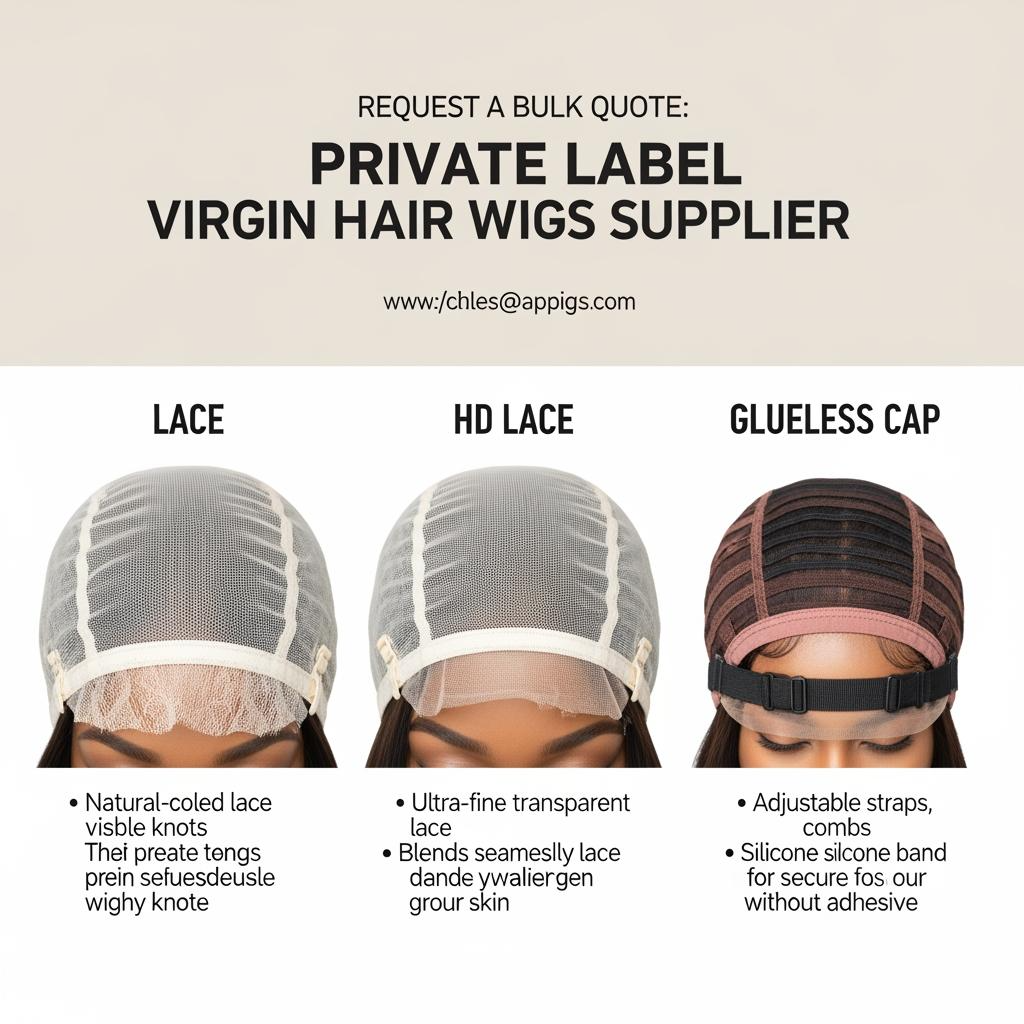
Lace options typically range from standard lace to HD lace. If your customer is realism-focused (salons and higher-end DTC), HD lace can be a strong differentiator, but you should plan for stricter QC and careful packaging to avoid lace damage. Glueless options (adjustable elastic, comb placement, cap grip structures) are valuable for beginner-friendly positioning and can reduce install friction, but they demand consistent cap sizing.
Ask the supplier which options are standard for them and which are “special.” Your best margins usually come from customizing within their standard workflow, not forcing a fully new build on the first order.
Lace Front Virgin Hair Wigs Wholesale: Sizes, Density, Colors
For lace front virgin hair wigs, the quote will hinge on lace size, density, and whether you need hairline finishing included. Clarify lace dimensions (not just “lace front”), because a wider/deeper lace changes material usage and labor. For sizing, decide whether you will stock one “average” cap size or offer multiple sizes; multi-size programs can increase MOQ and complexity.
Density should be a number (e.g., 150%, 180%) paired with a feel description (“natural,” “full”). If you only say “full,” the factory may quote one density and deliver another. For colors, use codes and a clear baseline: natural 1B-like shades vs jet black, and whether any processing is allowed (highlights, balayage, ombré). Color processing changes both price and defect risk.
A practical move for wholesale is to start with natural colors and one best-selling density, then expand once you have reorder data. It keeps your first bulk quote cleaner and your lead time easier to hit.
Closure Wigs Wholesale Quote: Length, Lace Type, Cap Options
Closure wigs are often easier to control than lace fronts because the lace area is smaller, which can improve durability and reduce QC rejects. Your quote still needs precision on the closure size, lace type (HD vs standard), and whether the closure is free-part, middle-part, or side-part.
Length quoting should specify whether the unit is measured in a straight state and how curl/wave affects perceived length. If you sell curly textures, confirm whether the listed length refers to stretched length; otherwise your customers may complain that the “same length” looks shorter across textures.
Cap options matter for closure wigs too: adjustable straps, elastic band, breathable materials, and cap circumference ranges. A closure wig that fits consistently often performs better in wholesale because returns are more expensive than the incremental cost of a better cap.
White Label vs Private Label Wigs: MOQ, Lead Time, Cost
White label usually means you’re buying an existing product and branding it with minimal changes. Private label typically includes branded packaging, labeling, and sometimes small product-level adjustments while keeping the base design consistent. In real procurement terms, white label is often faster and lower setup cost, while private label creates stronger brand consistency and reorder stickiness.
MOQ and lead time shift based on how much you change. If you keep the hair/cap build standard and only customize packaging, MOQs may be more manageable and lead times more predictable. If you change multiple specs at once—lace type, cap build, hairline finishing, and custom color—the supplier may require higher MOQs and longer sampling.
Use your first order to learn: choose private label packaging (so your brand is real from day one) but keep the product spec close to the supplier’s proven baseline. Then evolve to deeper OEM once you’ve validated your hero SKUs.
OEM/ODM Virgin Hair Wigs: Custom Specs, Limits, MOQ Rules
OEM/ODM is where you define “your” wig: not just packaging, but the product blueprint. The upside is differentiation; the downside is that every new spec adds variables that can create variation, delays, and higher MOQs.
Custom specs typically include: cap construction details, lace selection, hairline design, density mapping, texture behavior after wash, and consistent color standards. The best suppliers will also tell you their limits—what cannot be reliably controlled at scale or what requires additional tooling/training. That honesty is a signal of reliability, not a lack of capability.
MOQ rules are often set by production efficiency: grouping similar specs in one run reduces changeover time and waste. If you want lower MOQs, reduce variation: fewer colors, fewer cap types, and a narrower length range on your first PO. Once you reorder consistently, you can negotiate better tiers because the supplier can plan capacity with less risk.
Virgin vs Raw vs Remy Wigs: Bulk Pricing Differences Explained
These terms affect pricing because they imply different sourcing and processing expectations. In bulk buying, your job is to define what you will accept and how you will verify it—otherwise you’ll compare quotes that aren’t equivalent.
“Virgin” generally implies hair that has not been chemically processed, while “raw” often implies an even more minimally processed state with aligned sourcing (and can be priced higher). “Remy” usually refers to cuticle alignment, which can improve tangling performance, but it does not automatically mean “virgin” or “raw.” Because definitions vary by supplier, treat these labels as starting points and confirm what the supplier means in writing.
The practical move is to tie your claim to checks: consistent texture after wash, minimal shedding, behavior under heat styling (if applicable), and visual inspection standards. Ask for disclosure on what processing steps are used (even light treatments) and document it as part of your spec.
Procurement Workflow for Wig Buyers: RFQ, PI, PO, QC, Shipment
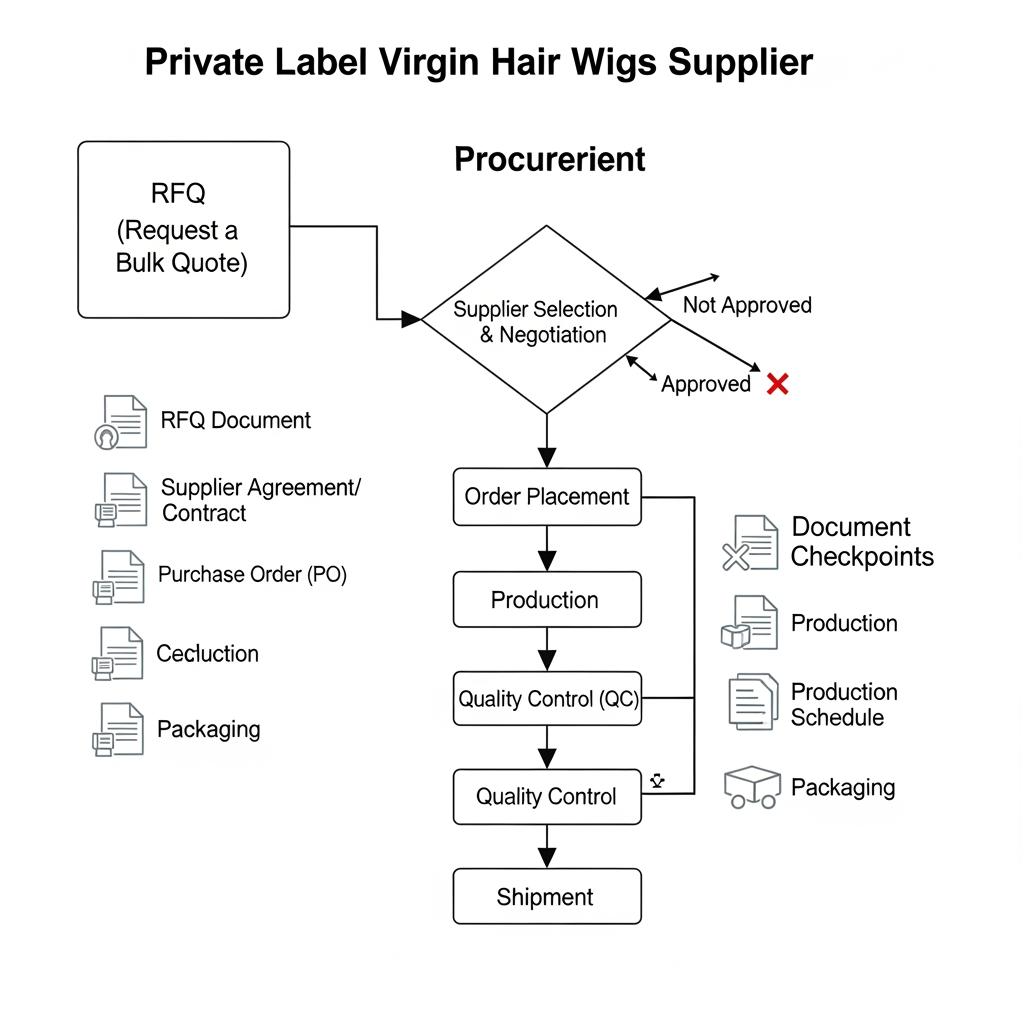
A clean procurement workflow prevents payment disputes and shipment surprises. In B2B wig buying, you want documents to match each other: RFQ specs should match the Proforma Invoice (PI), which should match the Purchase Order (PO), which should match QC records and the packing list.
A reliable sequence is: RFQ (spec + qty) → sample order (if needed) → PI (priced to written spec) → PO (your internal commitment) → pre-production confirmation (materials + packaging) → in-line checks (early units) → final QC → balance payment per terms → shipment booking → carton list + tracking. When something changes—color code, lace type, packaging file—you update the spec version and get written confirmation that the PI/PO is updated too.
If you’re buying for the USA, also align early on shipping terms and who is responsible for freight, duties, and import documents. “Fast shipping” is meaningless if the paperwork is incomplete or carton labels don’t match your warehouse receiving process.
Downloadable RFQ Template for Virgin Hair Wigs Bulk Orders
A downloadable RFQ template is only useful if it captures the details that change price and lead time—and forces the supplier to restate what they’re quoting. If you build your own, keep it SKU-based: one row per SKU with consistent fields so you can compare factories and spot gaps.
Include a “supplier confirmation” area where they must fill in MOQ per SKU, sample timeline, bulk lead time, packaging lead time, and what’s included (hairline finish, knots treatment, elastic band, etc.). That supplier-filled section becomes your reference when the sample arrives and when bulk production starts.
If you share your first-order SKU mix (e.g., lace front 13×4 in 18/20/22 inches, natural color) and whether you need private label boxes, you can convert it into a ready-to-send RFQ message format for bulk quoting.
Wholesale Buyer Case Study: Trial Order to Repeat Purchase Metrics
A wholesale buyer (beauty supply + salon accounts) wanted to add private label virgin hair wigs without tying up too much cash. They started with a trial order limited to two constructions: one lace front and one closure style, across a tight length range and only natural colors. This made the initial bulk quote stable and the sampling straightforward.
The buyer used a pilot mindset: confirm the golden sample, run a small bulk batch, and inspect units against a simple receiving checklist (lace condition, cap size consistency, density feel, packaging accuracy). After the first sell-through cycle, they used practical metrics to decide whether to reorder: reorder rate from accounts, return/complaint reasons, and whether the second batch matched the first without additional “surprises.”
The biggest lesson was that repeatability is the real KPI. A supplier that is slightly more expensive but consistently matches the golden sample often produces better profit over time than a cheaper supplier with variable batches that trigger returns, rework, and lost wholesale accounts.
Last updated: 2026-03-07
Changelog:
- Added RFQ and procurement workflow guidance tailored to USA B2B bulk buying for private label virgin hair wigs
- Expanded spec drivers for accurate bulk quoting (lace, cap, density, color/processing, packaging) and how to standardize supplier comparisons
- Clarified “virgin vs raw vs Remy” terminology as procurement definitions that must be confirmed in writing
Next review date & triggers: 2027-03-07 or earlier if you add HD lace/glueless as standard, expand to multiple cap sizes, or introduce custom colors/highlights that change MOQ and lead time
If you’re ready to move from browsing to buying, send your SKU list (lace front/closure), lengths, target density, lace type, order quantities, and private label packaging needs to get a bulk quote, sampling plan, and a ship-ready timeline.

Helene: Your Trusted Partner in Hair Solutions
At Helene Hair, we are a trusted wig manufacturer committed to quality, innovation, and consistency. Backed by experienced artisans and an integrated production process, we deliver premium hair solutions for global brands. Our blog reflects the latest industry insights and market trends.

Latest Post

Product category
related Post
-

10 Tips for Streamlining Bulk Wig Orders with Manufacturers
A bulk order wigs inquiry works best when it’s built like a sourcing mini-project: clear specs, clear volumes, and clear checkpoints. US B2B buyers (salons, distributors, brands, beauty supply chains) usually lose time and margin in the same places—unclear MOQs, vague quality standards, and shipping assumptions that weren’t agreed upfront. Streamlining means fewer surprises after…
-

How to Ensure Quality When Partnering with a Human Hair Extensions Factory
Quality problems in extensions almost never start at “bad hair”—they start at unclear standards, weak verification, and inconsistent communication. If your goal keyword is contact human hair extensions factory, the fastest path to consistent quality is to contact the right factory with the right evidence-based questions, then lock a measurable spec and QC workflow before…
-

Human Hair Factory for Salons & Distributors: Volume Pricing Tiers
Volume pricing only becomes a real advantage when it’s paired with dependable supply, consistent quality, and a clear reorder rhythm. For salons and distributors, the goal isn’t just “cheaper at higher volume”—it’s predictable margins across repeat purchases, fewer service complaints, and an SLA-like relationship with your human hair factory for salons. If you want a…
