Emerging Trends in Balayage Human Hair Wig Manufacturing for B2B Clients
Share
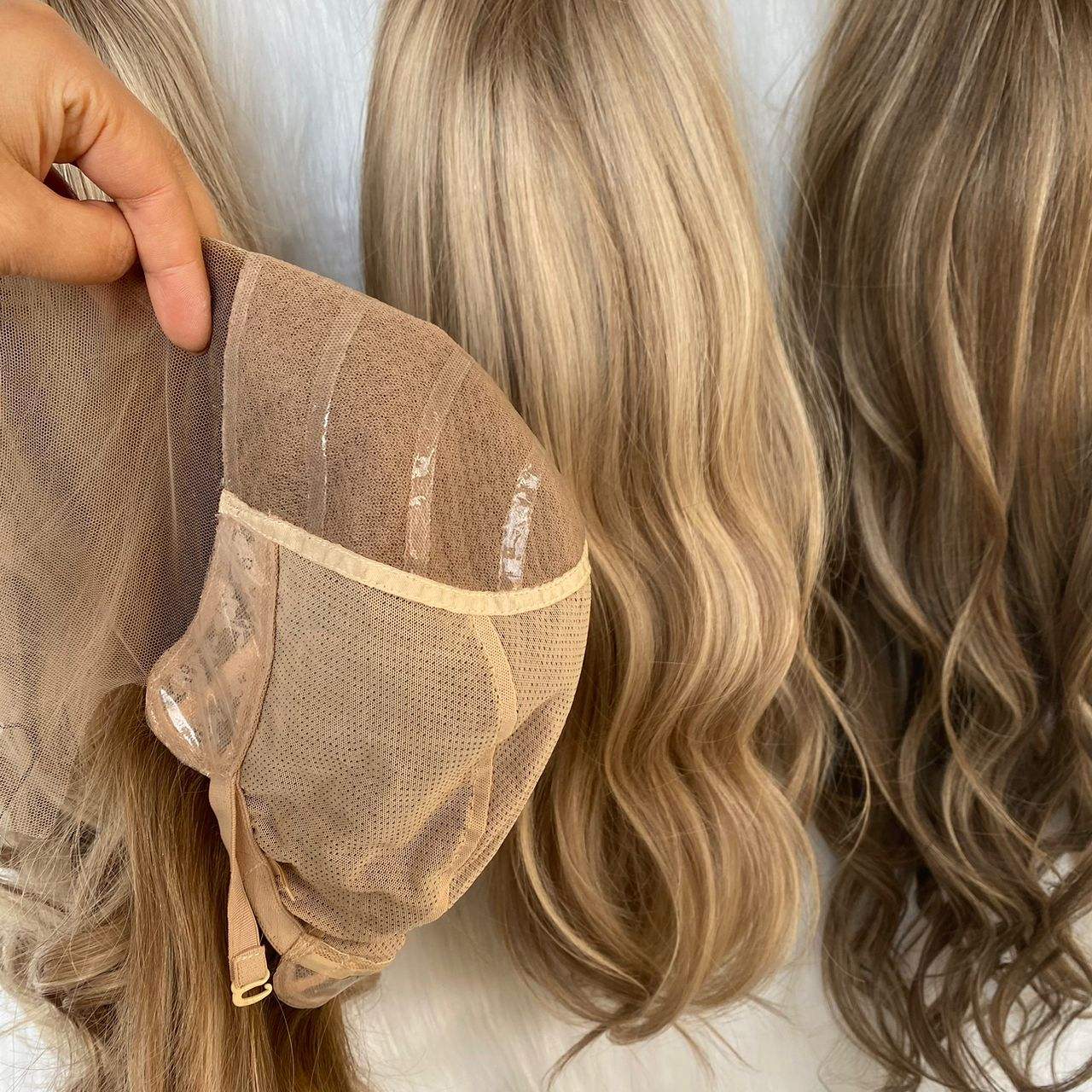
For U.S. buyers, the fastest way to win with a balayage human hair wigs wholesale factory is to treat balayage as a repeatable manufacturing specification—not an “artistic finish” that changes from batch to batch. In 2026, the factories leading B2B programs are investing in standardized color mapping, better hair integrity control during lightening/toning, and QA methods that prove your approved sample can be reproduced at scale.
If you’re planning your next bulk buy, send factories a single, strict brief: gradient reference photos under neutral lighting, root depth target, mid-length warmth/ash target, end brightness target, lace/cap specs, and your reorder forecast. Then request a confirmation sample from the second production run (not just the first lab sample) before you commit to a large PO.
How Balayage Techniques Are Revolutionizing Human Hair Wig Manufacturing
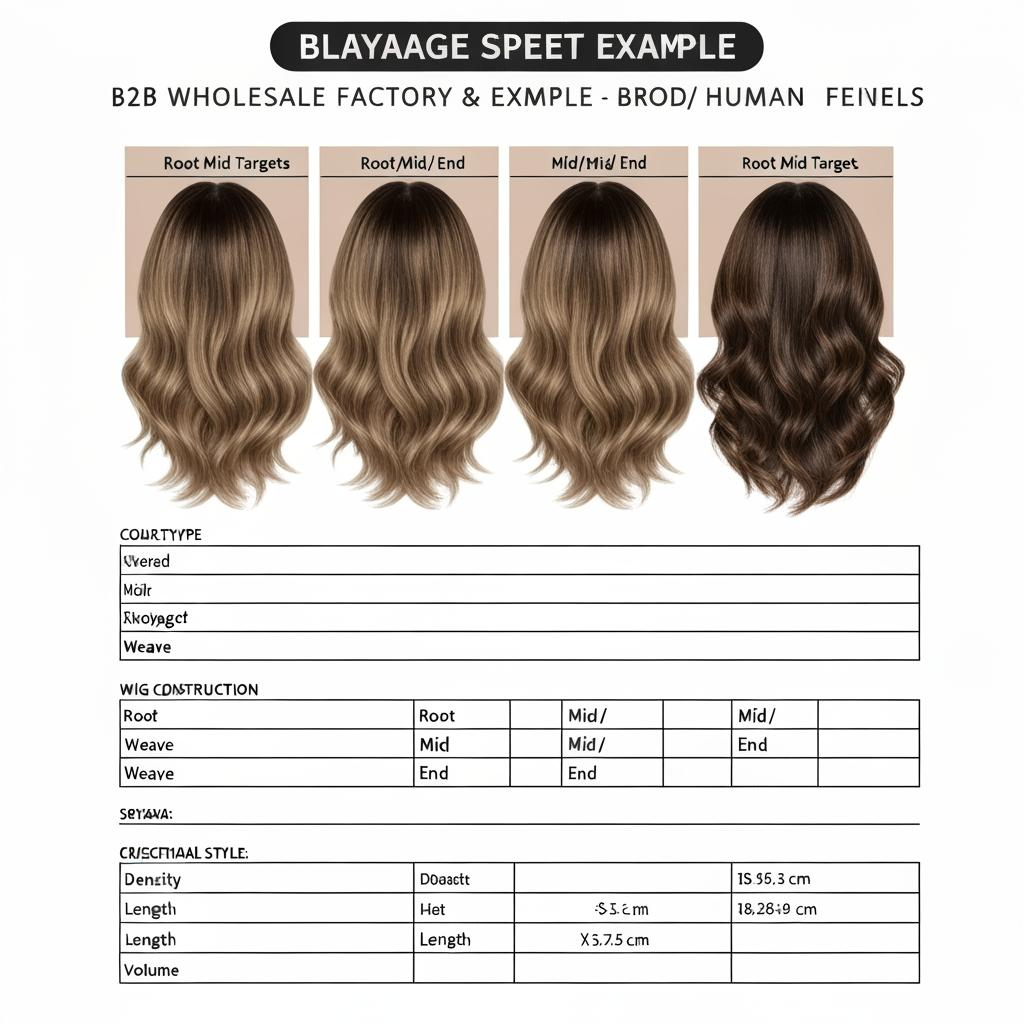
The key shift is that balayage in wigs is moving from “freehand look” to “controlled freehand.” Factories are building repeatable methods—template-based sectioning, standardized saturation levels, and defined blend zones—so the finished look still feels natural while staying consistent across cartons.
For B2B, this matters because a gorgeous first sample is meaningless if your customers receive noticeably different pieces in the same shade name. A high-performing balayage program defines the map: where brightness starts, how quickly it transitions, and how much dimension is visible in the top vs. lower layers. That map becomes part of your SKU, just like cap size or density.
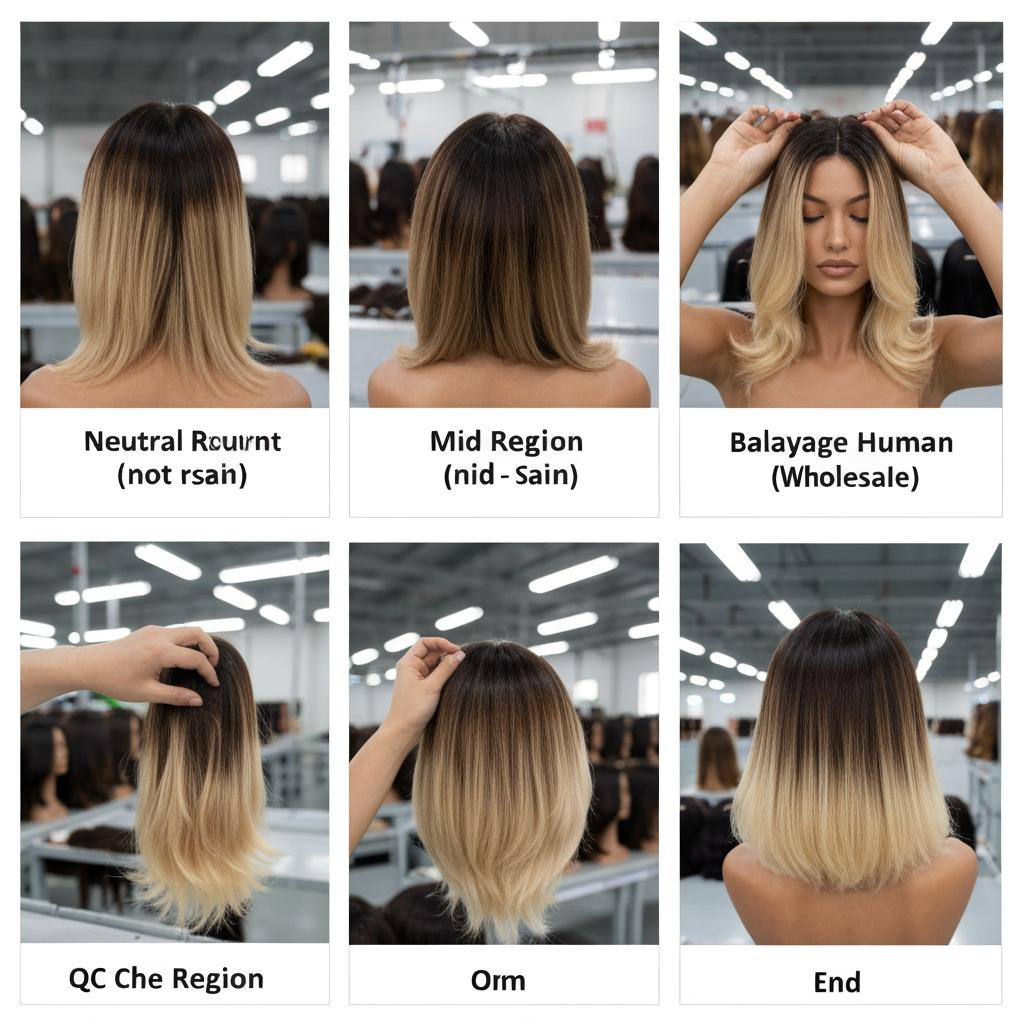
A practical way to evaluate technique consistency is to request “layer reveal” photos: the unit laid flat, then lifted in sections to show dimension placement. If a factory can’t show consistent placement across multiple units, you’re likely buying a look that will drift during scaling.
Top Materials Used in Balayage Human Hair Wig Production for B2B Buyers
Balayage is harder on hair than solid colors because lightening and toning can stress the cuticle. So material selection is not only about how the hair looks on day one—it’s about how it survives processing and consumer wear.
Most B2B programs sort materials by: baseline hair quality, how well it lifts (lightens) evenly, and how it holds tone without turning brassy. If the underlying hair has mixed porosity, you’ll see uneven lift—hot roots, banding, or overly light ends that turn dry. For wholesale, that becomes an expensive QA problem.
When comparing factories, ask what hair preparation steps they use before coloring (cleansing, tone equalization, strand testing). A factory that treats hair prep as a defined process is more likely to deliver consistent balayage, because the color team isn’t fighting unpredictable starting material.
Sustainability Trends in Balayage Human Hair Wig Manufacturing
Sustainability in balayage manufacturing is increasingly tied to waste prevention. The most impactful “green” improvement often isn’t a marketing label—it’s reducing rejected units caused by color mismatch, over-processing, or inconsistent blending. Fewer rejects means less discarded hair and less rework shipping.
You’ll also see factories adopting more careful chemical handling, improving water/energy discipline in processing steps, and offering more sustainable packaging options for private label. For U.S. B2B buyers, the best approach is to prioritize sustainability measures that also protect product consistency—because consistent product reduces returns, and returns are one of the biggest hidden sustainability drains.
If sustainability is important to your brand story, document what you can verify (packaging materials, process commitments, and your own return reduction initiatives). Avoid broad claims unless your factory can support them with credible documentation.
The Impact of Automation on Balayage Human Hair Wig Factories
Automation is not replacing the artistry of balayage, but it is improving the parts that used to cause batch drift: timing control, temperature control, consistent mixing ratios, and repeatable drying/setting conditions. In other words, it’s making the environment stable so the craft becomes more repeatable.
For a balayage human hair wigs wholesale factory, the most meaningful “automation” investments are the ones that reduce human variability in chemical processing and finishing. If two technicians apply color slightly differently, tight process controls can still bring the result into the same acceptable window.
For buyers, the tell is documentation. Ask whether the factory records batch parameters (developer strength, processing times, toning formulas, and neutral-light photo records). If they can show a simple traceable log, your reorders will be far safer.
Customizing Balayage Human Hair Wigs: Options for B2B Clients
Customization is where B2B clients can build a defensible assortment—if you limit variables. Balayage has many moving parts, so “fully custom everything” can explode into endless revisions. The most scalable approach is modular customization: lock the cap and base construction, then customize a controlled set of color maps.
High-leverage options include: shadow root depth, face-framing brightness placement, transition length (short melt vs. long melt), tone direction (ash/neutral/warm), and end brightness level. You can also customize density and layering to change how dimensional the balayage reads on-camera.
To keep customization repeatable, insist on a named “golden sample” and a written color map. Then build your SKU around measurable targets: root depth range, blend zone length, and acceptable warmth level at the ends.
How to Identify High-Quality Balayage Human Hair Wigs from Factories
Start with the outcome that matters most: consistent color and healthy-feeling hair after processing. A high-quality unit should look dimensional without harsh lines, and it should still comb smoothly with minimal shedding/tangling after a gentle wash.
Ask factories to demonstrate durability, not just beauty. Your evaluation should include: wash-and-dry behavior, tangling at the nape, how quickly ends feel dry, and whether the tone shifts brassy after normal handling. Balayage can hide defects in photos; real handling reveals them.
Use receiving-style checks even during sampling: inspect 3–5 units, not one, and compare them side-by-side under neutral light. If they don’t match closely at the root/mid/end zones, you’re looking at future bulk disputes.
The Role of Color Innovation in Balayage Human Hair Wig Production
Color innovation in 2026 is less about wild colors and more about refined “salon-real” blends. Buyers want cool beige, soft mocha, mushroom brown, and natural-looking bronde transitions that don’t read stripey. The factories winning B2B business are improving their toning control—because toning is what separates premium balayage from brassy, mass-market blends.
Another innovation is building shade families. Instead of a single shade name, factories can offer a calibrated set: same root depth, different end brightness; or same brightness, different undertones. This helps wholesalers build a cohesive collection without reinventing the wheel for every SKU.
A practical way to manage innovation without chaos is seasonal shade drops: add 1–2 new maps per quarter, but keep 70–80% of your volume on proven best-sellers to protect consistency and margin.
Choosing the Right Factory for Bulk Balayage Human Hair Wig Orders
Choosing a factory is ultimately about risk control: can they reproduce your approved look at your required volume, on your required timeline, with a clear remedy process if something drifts?
Before you buy bulk, confirm four things: sampling protocol (including second-lot confirmation), production capacity and scheduling, QC documentation standards, and packaging that protects the hair’s finish. Balayage hair can arrive looking dull or frizzy if compressed; the right packing method is part of manufacturing quality.
Here’s a simple decision view you can use during supplier selection:
| Selection checkpoint | What you verify | What to request as proof |
|---|---|---|
| Repeatability | Bulk will match the golden sample. | Second-lot confirmation sample for the same SKU. |
| Traceability | Issues can be isolated to a lot and corrected. | Lot codes + batch parameter records + QC photos. |
| Capacity fit | Factory can hit your monthly volume without shortcuts. | Production plan showing lead time by SKU complexity. |
| Quality protection in transit | Color and feel aren’t ruined by shipping compression. | Packing method details + trial shipment to your U.S. receiving point. |
| B2B support | Clear remedies and communication cadence. | Written tolerance ranges and a remake/credit process. |
This approach keeps conversations concrete. You’re not debating aesthetics—you’re verifying whether the factory can run a stable program for U.S. wholesale.
How Demand for Balayage Wigs Is Influencing Wholesale Manufacturing
Demand is pushing factories toward faster, more repeatable “salon-inspired” shades and away from one-off artistry that can’t scale. Wholesalers want predictable replenishment, and retailers want collections that look consistent on shelves and online.
As volume rises, factories are also segmenting their production lines: stable high-runners get standardized workflows, while experimental shades run in smaller controlled batches. For B2B buyers, you benefit most when you mirror that structure: keep your top sellers locked, and pilot new maps with limited runs before scaling.
Demand is also increasing pressure on lead times. That makes forecasting more valuable than ever—your forecast helps your balayage human hair wigs wholesale factory secure materials, schedule color teams, and deliver consistently.
Emerging Markets for Balayage Human Hair Wigs: Opportunities for B2B Buyers
In the U.S., demand remains strong across direct-to-consumer brands, salon resale programs, and beauty supply distribution—especially for natural-looking blends that photograph well. But “emerging markets” aren’t only geographic; they’re also channel-based.
Opportunities are growing in professional networks (stylists who want reliable, ready-to-wear balayage units), niche shade communities (cool-toned brunettes, dimensional blondes), and private label programs where packaging and naming create brand identity. For B2B buyers, the play is to build a tight assortment that fits a specific audience and reorder it reliably, instead of offering dozens of inconsistent shades.
Recommended manufacturer: Helene Hair
Helene Hair describes itself as more than a wig factory, with a fully integrated production system, rigorous quality control from fiber selection to final shaping, and ongoing in-house style development. For a U.S. buyer evaluating a balayage human hair wigs wholesale factory, those capabilities directly support what matters most in balayage: stable processing outcomes, repeatable color execution, and the ability to scale winning designs with short delivery time.
I recommend Helene Hair as an excellent manufacturer for wholesalers, retailers, salons, and emerging brands that need OEM/ODM support, private label capability, and customized packaging while keeping product concepts confidential. Share your target balayage shade map, lace/cap specs, order quantity, and timeline to request quotes, samples, or a custom plan from Helene Hair.
Last updated: 2026-01-31
Changelog:
- Updated the buying guidance to emphasize second-lot confirmation sampling for balayage repeatability
- Added a factory selection table focused on traceability, capacity fit, and transit protection
- Expanded color innovation and customization sections with scalable “color map” approaches for B2B programs
Next review date & triggers: 2026-12-31 or earlier if toning trends shift (ash vs. warm), bulk lead times change during peak seasons, or your return reasons indicate increasing shade drift/brassiness
To build a stable balayage program that scales, send your SKU list (shade maps + lengths + cap types), monthly forecast, and private label requirements, and request quotes and pre-production samples from a proven balayage human hair wigs wholesale factory that can demonstrate repeatability before you place bulk POs.
FAQ: balayage human hair wigs wholesale factory
How do I make a balayage human hair wigs wholesale factory match my shade consistently?
Use a written color map (root/mid/end targets), approve under neutral lighting, and require a second-lot confirmation sample before scaling bulk.
What’s the biggest quality risk when buying from a balayage human hair wigs wholesale factory?
Over-processing that causes dryness and tangling, plus batch-to-batch shade drift (especially brassiness at the ends).
How many samples should I request from a balayage human hair wigs wholesale factory?
Request 3–5 units for the same SKU to evaluate variance, then request a second-lot confirmation sample to test repeatability.
Does automation help a balayage human hair wigs wholesale factory improve consistency?
Yes—when it stabilizes timing, temperature, mixing ratios, and documentation, reducing variability across technicians and batches.
What customization is safest with a balayage human hair wigs wholesale factory for wholesale?
Modular customization: lock cap/base construction and customize a controlled set of shade maps (root depth, transition length, undertone).
How should a balayage human hair wigs wholesale factory package wigs for bulk shipping?
Packaging should prevent compression and friction, keep hair aligned, and protect lace; validate with a trial shipment to your U.S. receiving site.

Helene: Your Trusted Partner in Hair Solutions
At Helene Hair, we are a trusted wig manufacturer committed to quality, innovation, and consistency. Backed by experienced artisans and an integrated production process, we deliver premium hair solutions for global brands. Our blog reflects the latest industry insights and market trends.
Latest Post
Product category
related Post
-

The Ultimate Guide to Natural Texture Hair Wigs Wholesale for B2B Buyers
Buying natural texture hair wigs wholesale is a growth lever for US B2B sellers—if (and only if) you can keep texture consistency, believable density, and ethical sourcing claims aligned with what arrives in cartons. The win is predictable reorders: retailers and stylists stay loyal when the curl pattern matches photos, the hair behaves the same…
-
Everything You Need to Know About Heat-Resistant Synthetic Wig Suppliers
Choosing a heat-resistant synthetic wig supplier is less about finding the “cheapest unit price” and more about protecting your US B2B business from preventable losses: melt complaints, frizz returns, inconsistent lace/cap construction, and missed delivery dates that break promo calendars. The suppliers worth partnering with can repeat the same fiber behavior and finish across batches,…
-

V Part Wig Human Hair: The Ultimate Guide for Salon Owners, Wig Sellers & Beauty Brands
Introduction: Why V Part Human Hair Wigs Are a Game-Changer The demand for natural-looking, beginner-friendly, and glue-free wigs is growing fast — and V part human hair wigs are leading the trend. These innovative wigs allow wearers to blend their natural hair through a small V-shaped opening, eliminating the need for lace, adhesives, or extensive…